- Posts: 12446
- Thank you received: 1029
- Forum
- Open Forum
- Miscellaneous Research Topics
- General Airfield or 20th Century Military Architecture Discussion Topics
- wooden bombs
wooden bombs
- Peter Kirk
-

- Offline
- Moderator
-

Less
More
11 Mar 2010 18:50 #21
by Peter Kirk
No Amount Of Evidence Will Ever Persuade An Idiot (probably not Mark Twain)
Replied by Peter Kirk on topic wooden bombs
magic!
Rather like the stories of Elsans being thrown over enemy territory.
Rather like the stories of Elsans being thrown over enemy territory.
No Amount Of Evidence Will Ever Persuade An Idiot (probably not Mark Twain)
Please Log in or Create an account to join the conversation.
- PETERTHEEATER
-

- Offline
- Platinum Member
-

Less
More
- Posts: 10905
- Thank you received: 772
12 Mar 2010 06:14 #22
by PETERTHEEATER
Replied by PETERTHEEATER on topic wooden bombs
Excellent; thanks for the story.
Please Log in or Create an account to join the conversation.
- dewaerheid
- Visitor
-

23 Mar 2010 16:13 #23
by dewaerheid
Replied by dewaerheid on topic wooden bombs
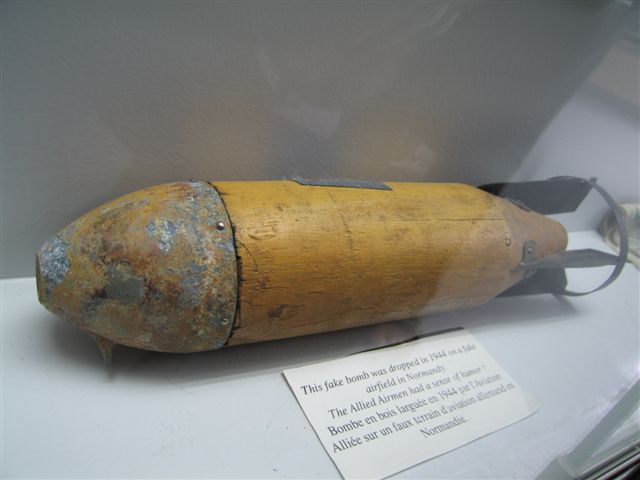
I assume the wooden bombs were for practice? The only other reasons I can think of is something to do with anti-magnetic or that wood was more available than metal.
I just bought two bombs in the States where the were produced in large quantities between 1936 and 1945 by 'Triumph Explosives Inc, Maryland !! These are so called smoke bombs but eyewitnesses in France did actually recognize them (70 years after the facts).
In the attachment you'll find thé bomb from the Airborne Museum in Sainte Mère l'Eglise, Normandy and also a good picture from a "smoke bomb".
Kind regards
Jean
Attached files
This image is hidden for guests.
This image is hidden for guests.
I just bought two bombs in the States where the were produced in large quantities between 1936 and 1945 by 'Triumph Explosives Inc, Maryland !! These are so called smoke bombs but eyewitnesses in France did actually recognize them (70 years after the facts).
In the attachment you'll find thé bomb from the Airborne Museum in Sainte Mère l'Eglise, Normandy and also a good picture from a "smoke bomb".
Kind regards
Jean
Attached files
This image is hidden for guests.
Please log in or register to see it.
This image is hidden for guests.
Please log in or register to see it.
Please Log in or Create an account to join the conversation.
- PETERTHEEATER
-
- Offline
- Platinum Member
-
Less
More
- Posts: 10905
- Thank you received: 772
24 Mar 2010 08:47 #24
by PETERTHEEATER
Replied by PETERTHEEATER on topic wooden bombs
Your second image looks to be a Flame Float.
Following impact after being dropped from an aircraft over the sea, the filling (usually calcium phosphide) would react with the water and produce a flame. The wooden body helped it to float and the metal nose ensured that it it adopted a vertical position with the tail UP. The flame issued from the tail end.
Used for navigational fixes and - allegedly - to illuminate an area of the sea around it.
Following impact after being dropped from an aircraft over the sea, the filling (usually calcium phosphide) would react with the water and produce a flame. The wooden body helped it to float and the metal nose ensured that it it adopted a vertical position with the tail UP. The flame issued from the tail end.
Used for navigational fixes and - allegedly - to illuminate an area of the sea around it.
Please Log in or Create an account to join the conversation.
- carnaby
-

- Offline
- Platinum Member
-
Less
More
- Posts: 5026
- Thank you received: 440
24 Mar 2010 13:26 #25
by carnaby
I read that the pilot would maintain a 'straight' course and the rear gunner would keep an eye on the float in the sea, which would give an estimate of 'drift'. (Something like that.)
Graham
Plan A is always more effective when the problem you are working on understands that Plan B will involve the use of dynamite
Replied by carnaby on topic wooden bombs
Excellent guys - I've always assumed these things looked like a miniature raft.dewaerheid's second image looks to be a Flame Float. Used for navigational fixes...
I read that the pilot would maintain a 'straight' course and the rear gunner would keep an eye on the float in the sea, which would give an estimate of 'drift'. (Something like that.)
Graham
Plan A is always more effective when the problem you are working on understands that Plan B will involve the use of dynamite
Please Log in or Create an account to join the conversation.
- PETERTHEEATER
-
- Offline
- Platinum Member
-
Less
More
- Posts: 10905
- Thank you received: 772
25 Mar 2010 07:47 #26
by PETERTHEEATER
Replied by PETERTHEEATER on topic wooden bombs
Exactly right Carnaby. Used at night to estimate drift rates and judge windspeed and direction. There were various types but all fuelled with carbide. The RAF dropped them from Flare Chutes and the USAAF from bomb carriers. Dependent on airspeed they could even be chucked through a door or gun-port.
Flare Chute release could be operated by the man who loaded it - usually on order of the pilot - or by the pilot from the cockpit so that he could 'time' the release to his requirement.
Flare Chute release could be operated by the man who loaded it - usually on order of the pilot - or by the pilot from the cockpit so that he could 'time' the release to his requirement.
Please Log in or Create an account to join the conversation.
- mermoz07
- Offline
- New Member
-

Less
More
- Posts: 1
- Thank you received: 0
10 Mar 2011 23:04 #27
by mermoz07
Replied by mermoz07 on topic wooden bombs
The view of Snopes is not very serious. I wrote them several times to tell them that I had found 163 cases on this story. No answer ... A German pilot veteran of WW2 who witnessed a drop of wooden bombs in 1943 send "a message in a bottle" to find the american or english pilot who threw wooden bombs on his head!! Look at
PA Courouble
Author of "The Riddle of wooden bombs"
PA Courouble
Author of "The Riddle of wooden bombs"
Please Log in or Create an account to join the conversation.
- REF
-

- Offline
- Platinum Member
-
Less
More
- Posts: 9794
- Thank you received: 652
10 Mar 2011 23:36 #28
by REF
Replied by REF on topic wooden bombs
There is a wooden torpedo ondisplay at Yeovilton, meant to take a photo of it last week but got distracted by something else and forgot!
Please Log in or Create an account to join the conversation.
- PETERTHEEATER
-
- Offline
- Platinum Member
-
Less
More
- Posts: 10905
- Thank you received: 772
13 Mar 2011 05:58 #29
by PETERTHEEATER
Replied by PETERTHEEATER on topic wooden bombs
Probably a 'recoverable' RN practice torpedo or an instructional item.
Please Log in or Create an account to join the conversation.
- Forum
- Open Forum
- Miscellaneous Research Topics
- General Airfield or 20th Century Military Architecture Discussion Topics
- wooden bombs
Time to create page: 0.062 seconds