- Posts: 1102
- Thank you received: 2
- Forum
- Open Forum
- Miscellaneous Research Topics
- General Airfield or 20th Century Military Architecture Discussion Topics
- Site near Matching Essex
Site near Matching Essex
- Denis
- Topic Author
- Offline
- Elite Member
-

Less
More
26 Jul 2009 15:45 #1
by Denis
Site near Matching Essex was created by Denis
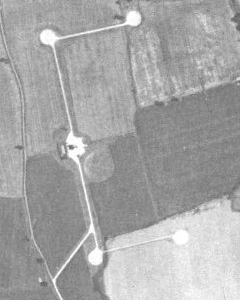
There is known locally a site just near Matching village. It was not connected with the airfield at Matching in any way. The largest building is known as the 'test hut'.
It has a picket post on the access road. This road leads to several small buildings, the larger looks like a workshop of some sort. all have concrete flat roofs. Ther are four round pads linked by a concrete track some ten foot wide.
I have no images of the buildings as I have yet to gain permission from the Farmer to enter. Any clues as to its former use? I have a hunch it could be a wartime searchlight battery.
One was in the area during 1940 as a Luftwaffe crew gave themselves up to it in September of 1940 after being shot down by a nightfighter from 25 Squadron. The Heinkel crashed no more than half a mile to the northeast.
So, did we have radar guided searchlights in 1940?.
www.flashearth.com/?lat=51.78103&lon=0.2...&z=16.3&r=0&src="msl"
It has a picket post on the access road. This road leads to several small buildings, the larger looks like a workshop of some sort. all have concrete flat roofs. Ther are four round pads linked by a concrete track some ten foot wide.
I have no images of the buildings as I have yet to gain permission from the Farmer to enter. Any clues as to its former use? I have a hunch it could be a wartime searchlight battery.
One was in the area during 1940 as a Luftwaffe crew gave themselves up to it in September of 1940 after being shot down by a nightfighter from 25 Squadron. The Heinkel crashed no more than half a mile to the northeast.
So, did we have radar guided searchlights in 1940?.
www.flashearth.com/?lat=51.78103&lon=0.2...&z=16.3&r=0&src="msl"
Please Log in or Create an account to join the conversation.
- Peter Kirk
-

- Offline
- Moderator
-

Less
More
- Posts: 12446
- Thank you received: 1029
26 Jul 2009 15:50 - 09 Sep 2017 17:47 #2
by Peter Kirk
No Amount Of Evidence Will Ever Persuade An Idiot (probably not Mark Twain)
Replied by Peter Kirk on topic Site near Matching Essex
It was certainly there just after the war and there is what appears to be a radar mat in the centre.
Searchlight batteries could do with a thread of their own as I am sure there are many still visible.
Attached files
This image is hidden for guests.
Searchlight batteries could do with a thread of their own as I am sure there are many still visible.
Attached files
This image is hidden for guests.
Please log in or register to see it.
No Amount Of Evidence Will Ever Persuade An Idiot (probably not Mark Twain)
Last edit: 09 Sep 2017 17:47 by netcompsys. Reason: fixed photos with filename spaces
Please Log in or Create an account to join the conversation.
- Denis
- Topic Author
- Offline
- Elite Member
-
Less
More
- Posts: 1102
- Thank you received: 2
26 Jul 2009 16:13 #3
by Denis
Replied by Denis on topic Site near Matching Essex
Thanks for the quick reply Peter. firstly what is a 'radar mat' please? I'm not familiar with anything remotely radar:-D
Does the layout resemble a searchlight battery? do you have a known S/L battery site visible on flashearth to compare it against?
Regards.
Does the layout resemble a searchlight battery? do you have a known S/L battery site visible on flashearth to compare it against?
Regards.
Please Log in or Create an account to join the conversation.
- horrocks
-

- Offline
- Senior Member
-

Less
More
- Posts: 233
- Thank you received: 4
30 Oct 2009 23:36 #4
by horrocks
Replied by horrocks on topic Site near Matching Essex
Denis, I have always been aware of the concrete service road leading off of the Tye road, and have always assumed the this was a Matching Airfield dispersed site of some kind.
Did your enquiries draw any conclusions?
Did your enquiries draw any conclusions?
Please Log in or Create an account to join the conversation.
- Denis
- Topic Author
- Offline
- Elite Member
-
Less
More
- Posts: 1102
- Thank you received: 2
31 Oct 2009 09:13 #5
by Denis
Replied by Denis on topic Site near Matching Essex
No Horrocks,
It is definately not Matching airfield related, The one fellow who does know is in a long term illness.
We will find out though!
It is definately not Matching airfield related, The one fellow who does know is in a long term illness.
We will find out though!
Please Log in or Create an account to join the conversation.
- Peter Kirk
-
- Offline
- Moderator
-
Less
More
- Posts: 12446
- Thank you received: 1029
31 Oct 2009 10:50 #6
by Peter Kirk
No Amount Of Evidence Will Ever Persuade An Idiot (probably not Mark Twain)
Replied by Peter Kirk on topic Site near Matching Essex
Denis,
Just noticed I didn't reply to your question from July. Apologies.
If you haven't already found out what a radar mat is then all I know is it is for radar guidance of AA guns and in this case Searchlights. I think it was to help with prediction of targets so that shells could be fired more accurately to "meet" the target aircraft. Not sure how this fits with Searchlights as they tend to travel as the speed of light!
The mat itself was a mesh, probably chicken wire, and its exact funtion is best explained by a radar expert. I think it was answered somewhere on the forum.
Peter
Just noticed I didn't reply to your question from July. Apologies.
If you haven't already found out what a radar mat is then all I know is it is for radar guidance of AA guns and in this case Searchlights. I think it was to help with prediction of targets so that shells could be fired more accurately to "meet" the target aircraft. Not sure how this fits with Searchlights as they tend to travel as the speed of light!
The mat itself was a mesh, probably chicken wire, and its exact funtion is best explained by a radar expert. I think it was answered somewhere on the forum.
Peter
No Amount Of Evidence Will Ever Persuade An Idiot (probably not Mark Twain)
Please Log in or Create an account to join the conversation.
- carnaby
-

- Offline
- Platinum Member
-

Less
More
- Posts: 5026
- Thank you received: 440
31 Oct 2009 15:52 #7
by carnaby
Aerials would work much more predictably if the 'earth' on which they were mounted was made of steel, or copper, or some other very electrically conductive medium. As they proved with the SBA transmitter, you could calibrate the system only to find that everything changed when it rained. If the ground got uniformly wet it might just be acceptable, but sand and clay mixes behave very differently when moist and are completely unacceptable.
Solution - make an artificial ground covering using chicken wire. As in the Faraday shield, if the wavelength of the radar is larger than the holes in the chicken wire, it's as good as a solid sheet of metal.
Graham
Plan A is always more effective when the problem you are working on understands that Plan B will involve the use of dynamite
Replied by carnaby on topic Site near Matching Essex
The mat itself was a mesh, probably chicken wire, and its exact funtion is best explained by a radar expert. I think it was answered somewhere on the forum.
Aerials would work much more predictably if the 'earth' on which they were mounted was made of steel, or copper, or some other very electrically conductive medium. As they proved with the SBA transmitter, you could calibrate the system only to find that everything changed when it rained. If the ground got uniformly wet it might just be acceptable, but sand and clay mixes behave very differently when moist and are completely unacceptable.
Solution - make an artificial ground covering using chicken wire. As in the Faraday shield, if the wavelength of the radar is larger than the holes in the chicken wire, it's as good as a solid sheet of metal.
Graham
Plan A is always more effective when the problem you are working on understands that Plan B will involve the use of dynamite
Please Log in or Create an account to join the conversation.
- Denis
- Topic Author
- Offline
- Elite Member
-
Less
More
- Posts: 1102
- Thank you received: 2
01 Nov 2009 12:05 #8
by Denis
No problem Peter, So if my understanding of yours and Grahams explanation is correct, it could well be a Radar controlled searchlight site.
My other question still stands as to if we were using radar controlled searchlights in 1940. That is if the site was not adapted from normal controlled searchlights, to a radar controlled type at a later date of course!
Replied by Denis on topic Site near Matching Essex
Denis,
Just noticed I didn't reply to your question from July. Apologies.
Peter
No problem Peter, So if my understanding of yours and Grahams explanation is correct, it could well be a Radar controlled searchlight site.
My other question still stands as to if we were using radar controlled searchlights in 1940. That is if the site was not adapted from normal controlled searchlights, to a radar controlled type at a later date of course!
Please Log in or Create an account to join the conversation.
- Peter Kirk
-
- Offline
- Moderator
-
Less
More
- Posts: 12446
- Thank you received: 1029
01 Nov 2009 12:31 #9
by Peter Kirk
My understanding is no we weren't. Again hopefully someone knows for certain.
No Amount Of Evidence Will Ever Persuade An Idiot (probably not Mark Twain)
Replied by Peter Kirk on topic Site near Matching Essex
My other question still stands as to if we were using radar controlled searchlights in 1940.
My understanding is no we weren't. Again hopefully someone knows for certain.
No Amount Of Evidence Will Ever Persuade An Idiot (probably not Mark Twain)
Please Log in or Create an account to join the conversation.
- carnaby
-
- Offline
- Platinum Member
-
Less
More
- Posts: 5026
- Thank you received: 440
01 Nov 2009 13:25 #10
by carnaby
Some good diagrams and pictures of the 'GL' mat in this book.
Graham
Plan A is always more effective when the problem you are working on understands that Plan B will involve the use of dynamite
Replied by carnaby on topic Site near Matching Essex
My guess would agree with PNKs, but a search through Colin Dobinson's AA Command shows otherwise. 'Elsie' (searchlight control SLC) began in late 1940 and was well underway by the spring of 1941.My other question still stands as to if we were using radar controlled searchlights in 1940.
Some good diagrams and pictures of the 'GL' mat in this book.
Graham
Plan A is always more effective when the problem you are working on understands that Plan B will involve the use of dynamite
Please Log in or Create an account to join the conversation.
- Forum
- Open Forum
- Miscellaneous Research Topics
- General Airfield or 20th Century Military Architecture Discussion Topics
- Site near Matching Essex
Time to create page: 0.046 seconds