- Posts: 9794
- Thank you received: 652
- Forum
- Open Forum
- Miscellaneous Research Topics
- General Airfield or 20th Century Military Architecture Discussion Topics
- Runway Markings
Runway Markings
- REF
-
 Topic Author
- Offline
- Platinum Member
-

Less
More
11 Jul 2009 09:22 - 16 Apr 2017 23:02 #1
by REF
Runway Markings was created by REF
New thread - spin off from REF's
Long Newnton
which went off topic.
Last edit: 16 Apr 2017 23:02 by carnaby.
Please Log in or Create an account to join the conversation.
- manda
- Visitor
-

19 Apr 2010 15:30 #2
by manda
Replied by manda on topic Runway Markings
I have just mapped (digitised) RAF Long Newnton from the RAF vertical photographs, thanks REF and Richard for your ground shots, they proved very useful for identifying the different buildings. Here's a couple of cropped vertical images....
Photo Source: English Heritage (NMR) RAF Photography
Attached files [IMG]/community/43445=1766-Long Newnton NMR RAF-106G-UK-1721 4157 06-SEP-1946 .jpg[/img] [IMG]/community/43445=1767-NMR RAF-CPE-UK-2110 3078 28-MAY-1947.jpg[/img]
Photo Source: English Heritage (NMR) RAF Photography
Attached files [IMG]/community/43445=1766-Long Newnton NMR RAF-106G-UK-1721 4157 06-SEP-1946 .jpg[/img] [IMG]/community/43445=1767-NMR RAF-CPE-UK-2110 3078 28-MAY-1947.jpg[/img]
Please Log in or Create an account to join the conversation.
- Ossington_2008
- Offline
- Platinum Member
-
Less
More
- Posts: 1645
- Thank you received: 163
19 Apr 2010 16:08 #3
by Ossington_2008
Replied by Ossington_2008 on topic Runway Markings
I have never seen Xs used to denote a closed grass runway before. Is this unique? (even if its painted on peritrack rather than grass.) And why only one runway so marked? Are those cubes stored bombs?
Please Log in or Create an account to join the conversation.
- Peter Kirk
-

- Offline
- Moderator
-

Less
More
- Posts: 12446
- Thank you received: 1029
19 Apr 2010 17:56 #4
by Peter Kirk
No Amount Of Evidence Will Ever Persuade An Idiot (probably not Mark Twain)
Replied by Peter Kirk on topic Runway Markings
I have noted the white X on a number of grass aerodromes, can lay my hands on one yet but the oddity is that sometimes they come out as a + due to
bad orientation!
The runway lighting looks a bit hefty though
The runway lighting looks a bit hefty though
No Amount Of Evidence Will Ever Persuade An Idiot (probably not Mark Twain)
Please Log in or Create an account to join the conversation.
- Peter Kirk
-
- Offline
- Moderator
-
Less
More
- Posts: 12446
- Thank you received: 1029
19 Apr 2010 19:15 #5
by Peter Kirk
No Amount Of Evidence Will Ever Persuade An Idiot (probably not Mark Twain)
Replied by Peter Kirk on topic Runway Markings
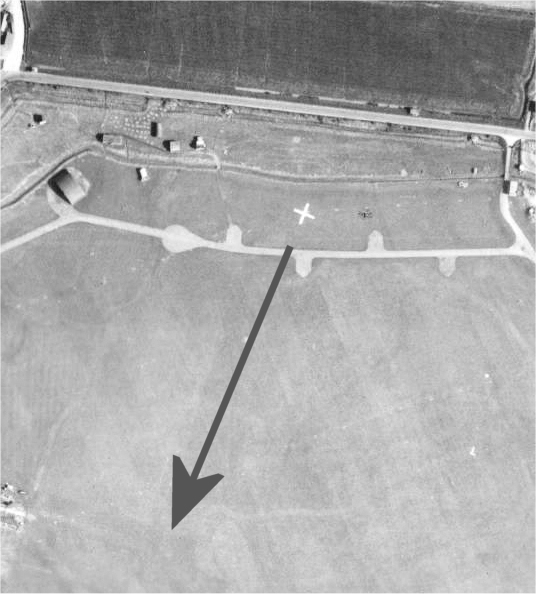
Back to the white Xs. This is Shoreham and the X is a + as the runway follows the arrow. There is another white cross at the other end. Babdown Farm also had white crosses. The difference with Long Newnton is the marking is on the peri-track.
With the ammo storage would all these sub-sites have had staff stationed there 24/7? Also would they have had an RAF station board at the main gate/entrance, rather like the Bungay one (if anyone knows to the pic I am referring to)?
Interesting that a simple airfield pic can spawn a so many related queries.
Attached files
This image is hidden for guests.
With the ammo storage would all these sub-sites have had staff stationed there 24/7? Also would they have had an RAF station board at the main gate/entrance, rather like the Bungay one (if anyone knows to the pic I am referring to)?
Interesting that a simple airfield pic can spawn a so many related queries.
Attached files
This image is hidden for guests.
Please log in or register to see it.
No Amount Of Evidence Will Ever Persuade An Idiot (probably not Mark Twain)
Please Log in or Create an account to join the conversation.
- manda
- Visitor
-
20 Apr 2010 08:44 - 18 Dec 2016 19:14 #6
by manda
Replied by manda on topic Runway Markings
Thought you guys might like that one
I have seen a few X's denoting closed runways on some airfields i've came across. I think one was Moreton Valence, and am sure it was placed on the peri track as well. (i'll check that one). Yup i suspected the small 'cubes' were some sort of ammo/explosive storage, being well spaced apart.
One question I was going to ask. Does a circular 'o' within a signal square denote 'explosives stored at airfield'? i know there's meant to be some sort of signal for that, just can't remember.
I have seen a few X's denoting closed runways on some airfields i've came across. I think one was Moreton Valence, and am sure it was placed on the peri track as well. (i'll check that one). Yup i suspected the small 'cubes' were some sort of ammo/explosive storage, being well spaced apart.
One question I was going to ask. Does a circular 'o' within a signal square denote 'explosives stored at airfield'? i know there's meant to be some sort of signal for that, just can't remember.
Last edit: 18 Dec 2016 19:14 by netcompsys. Reason: Fotopic web site gone away
Please Log in or Create an account to join the conversation.
- OneEighthBit
-
- Offline
- Elite Member
-

Less
More
- Posts: 795
- Thank you received: 13
20 Apr 2010 09:07 #7
by OneEighthBit
Replied by OneEighthBit on topic Runway Markings
I remember having to learn the ground signals as part of my PPL. The same ones are still used today although the context has changed slightly.
In WWII terms, in the signals square (near the tower) a red square with a yellow cross denoted a total landing prohibition at the airfield. However a white cross at the end of a grass or asphalt runway meant that the runway was disused and you should only land in an emergency. A white cross in the middle of a grass airfield denotes that the entire landing area was disused.
A cross with a white underline denotes that the airfield has been abandoned but that the landing areas/runways had been inspected within the last 6 months and deemed safe for emergency landings.
If explosives were stored on the runway it was marked as an underlined EX.
I've never come across and "O" marking on a runway but a hollow square in the signals board mean the airfield was being used for bombing practice and although the standard was a yellow cross, I've seen a large C used to denote a cable dropping area for glider tugs.
In WWII terms, in the signals square (near the tower) a red square with a yellow cross denoted a total landing prohibition at the airfield. However a white cross at the end of a grass or asphalt runway meant that the runway was disused and you should only land in an emergency. A white cross in the middle of a grass airfield denotes that the entire landing area was disused.
A cross with a white underline denotes that the airfield has been abandoned but that the landing areas/runways had been inspected within the last 6 months and deemed safe for emergency landings.
If explosives were stored on the runway it was marked as an underlined EX.
I've never come across and "O" marking on a runway but a hollow square in the signals board mean the airfield was being used for bombing practice and although the standard was a yellow cross, I've seen a large C used to denote a cable dropping area for glider tugs.
Please Log in or Create an account to join the conversation.
- manda
- Visitor
-
20 Apr 2010 09:16 #8
by manda
Replied by manda on topic Runway Markings
Thanks, here's a close up. Guess it could be a square not a circle
Also note the 'T' at the top, it looks as though it has been moved from the signal square??
Photo Source: English Heritage (NMR) RAF Photography
Attached files [IMG]/community/43452=1769-LN Signal NMR RAF-106G-UK-1721 4157 06-SEP-1946crop .jpg[/img]
Also note the 'T' at the top, it looks as though it has been moved from the signal square??
Photo Source: English Heritage (NMR) RAF Photography
Attached files [IMG]/community/43452=1769-LN Signal NMR RAF-106G-UK-1721 4157 06-SEP-1946crop .jpg[/img]
Please Log in or Create an account to join the conversation.
- carnaby
-

- Offline
- Platinum Member
-
Less
More
- Posts: 5026
- Thank you received: 440
20 Apr 2010 09:27 #9
by carnaby
From my notes:
[FONT="]... in October 1945 when a DH Dominie en route from Stretton to Halesworth landed at Attlebridge amongst piles of bombs stored on the runway. The pilot, a Naval officer, had failed to notice the white 'landing prohibited' crosses painted at the ends of the runways.[/FONT]
I believe Llandwrog had 'EX' on the end of its runways post war. This would make sense relating to either 'EXplosives', or Explosives + 'X' for 'landing prohibited'. (Except in this case it was chemical weapons, not explosives - nothing is simple) .
The 1953 Naval 'Air Traffic Control Regulations (BR1899') states: abandoned airfields will a show a white cross consisting of two bars 5' by 60' at the end of each runway. The signals square is to be obliterated.
In October 1946 Long Newton stored 6,000 tons of weapons. A Class 'A' airfield was storing up to 10,000 tons at that time. It had been hoped to store 15 kt per airfield but this figure had proved optimistic, and the stocks had to be stored less densely to allow frequent maintenance and inspection.
Graham
Plan A is always more effective when the problem you are working on understands that Plan B will involve the use of dynamite
Replied by carnaby on topic Runway Markings
Haven't heard that one, Manda - maybe correct?). One question I was going to ask. Does a circular 'o' within a signal square denote 'explosives stored at airfield'? i know there's meant to be some sort of signal for that, just can't remember.
From my notes:
[FONT="]... in October 1945 when a DH Dominie en route from Stretton to Halesworth landed at Attlebridge amongst piles of bombs stored on the runway. The pilot, a Naval officer, had failed to notice the white 'landing prohibited' crosses painted at the ends of the runways.[/FONT]
I believe Llandwrog had 'EX' on the end of its runways post war. This would make sense relating to either 'EXplosives', or Explosives + 'X' for 'landing prohibited'. (Except in this case it was chemical weapons, not explosives - nothing is simple) .
The 1953 Naval 'Air Traffic Control Regulations (BR1899') states: abandoned airfields will a show a white cross consisting of two bars 5' by 60' at the end of each runway. The signals square is to be obliterated.
In October 1946 Long Newton stored 6,000 tons of weapons. A Class 'A' airfield was storing up to 10,000 tons at that time. It had been hoped to store 15 kt per airfield but this figure had proved optimistic, and the stocks had to be stored less densely to allow frequent maintenance and inspection.
Graham
Plan A is always more effective when the problem you are working on understands that Plan B will involve the use of dynamite
Please Log in or Create an account to join the conversation.
- manda
- Visitor
-
20 Apr 2010 09:28 #10
by manda
Its not clear on the attached AP but both are marked with 'X's
Replied by manda on topic Runway Markings
And why only one runway so marked?
Its not clear on the attached AP but both are marked with 'X's
Please Log in or Create an account to join the conversation.
- Forum
- Open Forum
- Miscellaneous Research Topics
- General Airfield or 20th Century Military Architecture Discussion Topics
- Runway Markings
Time to create page: 0.055 seconds

![[IMG]/community/43445=1766-Long Newnton NMR RAF-106G-UK-1721 4157 06-SEP-1946 .jpg[/img]](/community/43445=1766-Long%20Newnton%20NMR%20RAF-106G-UK-1721%204157%2006-SEP-1946%20.jpg)
![[IMG]/community/43445=1767-NMR RAF-CPE-UK-2110 3078 28-MAY-1947.jpg[/img]](/community/43445=1767-NMR%20RAF-CPE-UK-2110%203078%2028-MAY-1947.jpg)
![[IMG]/community/43452=1769-LN Signal NMR RAF-106G-UK-1721 4157 06-SEP-1946crop .jpg[/img]](/community/43452=1769-LN%20Signal%20NMR%20RAF-106G-UK-1721%204157%2006-SEP-1946crop%20.jpg)