- Posts: 255
- Thank you received: 1
- Forum
- Open Forum
- Miscellaneous Research Topics
- General Airfield or 20th Century Military Architecture Discussion Topics
- WW2 Decoy Sites
WW2 Decoy Sites
- Gypsymoth
- Topic Author
- Offline
- Senior Member
-

Less
More
11 Sep 2014 22:16 #1
by Gypsymoth
WW2 Decoy Sites was created by Gypsymoth
Apologies if this is in the wrong place. All the pictures I've seen so far have been of building remains. Can I assume that all Q site, say, control bunkers (or whatever they were called) would have had protective earth banking over & around them, so all that might have been seen was the entrance steps & not much else. They'd have looked like Stanton Shelters did, for example? A big grassy mound?
Please Log in or Create an account to join the conversation.
- CornwallPhil
-

- Offline
- Elite Member
-

Less
More
- Posts: 870
- Thank you received: 163
11 Sep 2014 23:25 #2
by CornwallPhil
This image is hidden for guests.
The Nare Head Decoy Command Bunker. The observation "window" and escape hatch would have protruded above the mound, in this case at the left end. The Nare Point Decoy Command Bunker was built into the side of the hill to help disguise it from the air. Nare Point and Nare Head were two of the QF Starfish sites for Falmouth in Cornwall.
Replied by CornwallPhil on topic WW2 Decoy Sites
This image is hidden for guests.
Please log in or register to see it.
The Nare Head Decoy Command Bunker. The observation "window" and escape hatch would have protruded above the mound, in this case at the left end. The Nare Point Decoy Command Bunker was built into the side of the hill to help disguise it from the air. Nare Point and Nare Head were two of the QF Starfish sites for Falmouth in Cornwall.
Please Log in or Create an account to join the conversation.
- Harboda77
- Offline
- Platinum Member
-

Less
More
- Posts: 1500
- Thank you received: 123
12 Sep 2014 06:47 #3
by Harboda77
Replied by Harboda77 on topic WW2 Decoy Sites
CornwallPhil ~ I remember being informed at the Nare hotel that there had been over 200 SF sites constructed by 1945 some one had estimated that they had successfully diverted approximately one thousand ton of bombs.
Do you know if Nare Head was ever bombed ?
Dave.
Do you know if Nare Head was ever bombed ?
Dave.
Please Log in or Create an account to join the conversation.
- deprecated
- Visitor
-

12 Sep 2014 07:39 #4
by deprecated
Yes, the decoy shelters were generally earth covered. Though most that remain have lost their earth covering there are still some examples that retain it.
There is a dedicated sub-section for Decoy Sites within 'Non Airfield Sites'. You'll find information about some specific decoys, book references and a couple of decoy lists I transcribed from 'Dobinson' and AIR 20/4352
Replied by deprecated on topic WW2 Decoy Sites
Apologies if this is in the wrong place. All the pictures I've seen so far have been of building remains. Can I assume that all Q site, say, control bunkers (or whatever they were called) would have had protective earth banking over & around them, so all that might have been seen was the entrance steps & not much else. They'd have looked like Stanton Shelters did, for example? A big grassy mound?
Yes, the decoy shelters were generally earth covered. Though most that remain have lost their earth covering there are still some examples that retain it.
There is a dedicated sub-section for Decoy Sites within 'Non Airfield Sites'. You'll find information about some specific decoys, book references and a couple of decoy lists I transcribed from 'Dobinson' and AIR 20/4352
Please Log in or Create an account to join the conversation.
- deprecated
- Visitor
-
12 Sep 2014 07:41 #5
by deprecated
Is there any evidence of the blast wall? Difficult to gauge compression of perspective but I'd have expected to see it on your photo. Has the earth covering been renewed on this shelter?
Replied by deprecated on topic WW2 Decoy Sites
This image is hidden for guests.
Please log in or register to see it.
The Nare Head Decoy Command Bunker. The observation "window" and escape hatch would have protruded above the mound, in this case at the left end. The Nare Point Decoy Command Bunker was built into the side of the hill to help disguise it from the air. Nare Point and Nare Head were two of the QF Starfish sites for Falmouth in Cornwall.
Is there any evidence of the blast wall? Difficult to gauge compression of perspective but I'd have expected to see it on your photo. Has the earth covering been renewed on this shelter?
Please Log in or Create an account to join the conversation.
- CornwallPhil
-
- Offline
- Elite Member
-
Less
More
- Posts: 870
- Thank you received: 163
12 Sep 2014 08:24 #6
by CornwallPhil
Replied by CornwallPhil on topic WW2 Decoy Sites
I have not come across any record of Nare Head Decoy being bombed but the fact there were bombs on farms in the Roseland peninsula on nights when it was operated would suggest it achieved its purpose in luring the bombers away from Falmouth. Thunderstorms seem to have done most damage to the Decoy Site!Do you know if Nare Head was ever bombed ?
Please Log in or Create an account to join the conversation.
- Gypsymoth
- Topic Author
- Offline
- Senior Member
-
Less
More
- Posts: 255
- Thank you received: 1
12 Sep 2014 08:25 #7
by Gypsymoth
Replied by Gypsymoth on topic WW2 Decoy Sites
Hello Iain,
I've just made 3 Q decoy sites for my flight sim for this part of the New Forest (Holmesly South/Stoney Cross/Ibsley) being Ridley Plain, Verwood & Woodgreen. Whilst researching them I checked AiX & came across some great pictures & other information here. Whilst pondering how to present buildings I suddenly thought they probably would be disguised with earth protection, hence my question. This screenshot is what I've cobbled together in the past 5 mins without the parts that would normally protrude. I'll add these later.
This image is hidden for guests.
CornwallPhil's nice picture gave me the idea for the entrance - thanks. I've added a blast wall as most photos seem to have one, or two even.
I now have your superb list of sites, Iain, thank you.
I've just made 3 Q decoy sites for my flight sim for this part of the New Forest (Holmesly South/Stoney Cross/Ibsley) being Ridley Plain, Verwood & Woodgreen. Whilst researching them I checked AiX & came across some great pictures & other information here. Whilst pondering how to present buildings I suddenly thought they probably would be disguised with earth protection, hence my question. This screenshot is what I've cobbled together in the past 5 mins without the parts that would normally protrude. I'll add these later.
This image is hidden for guests.
Please log in or register to see it.
CornwallPhil's nice picture gave me the idea for the entrance - thanks. I've added a blast wall as most photos seem to have one, or two even.
I now have your superb list of sites, Iain, thank you.
Please Log in or Create an account to join the conversation.
- CornwallPhil
-
- Offline
- Elite Member
-
Less
More
- Posts: 870
- Thank you received: 163
12 Sep 2014 08:36 #8
by CornwallPhil
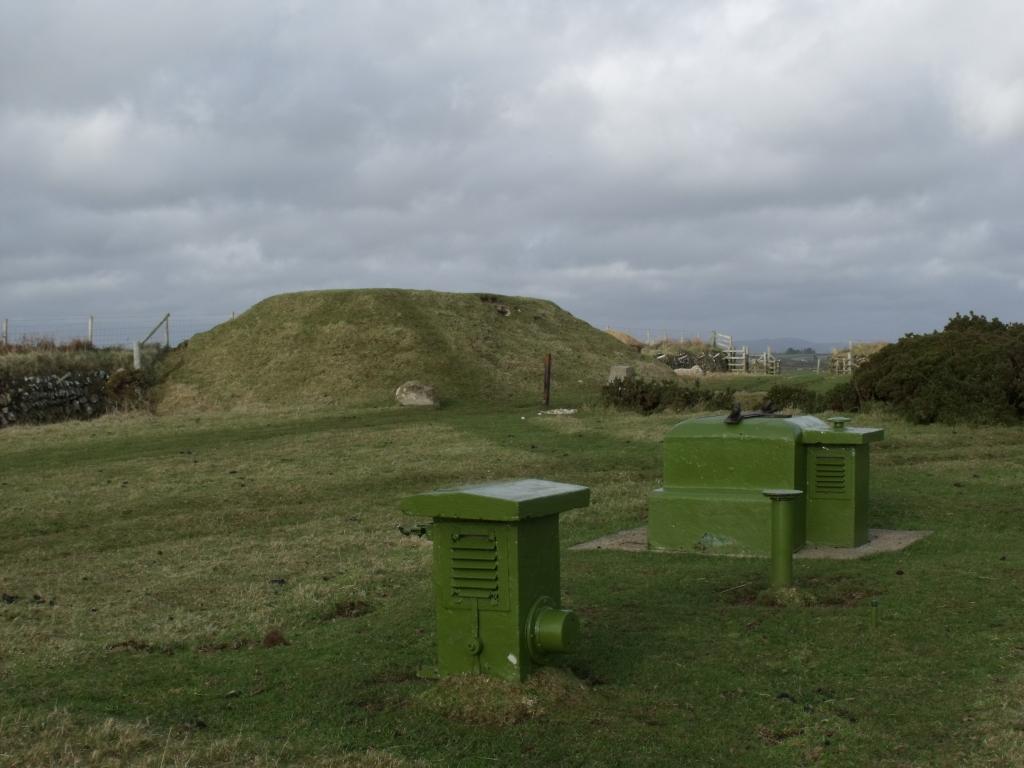
Yes there was originally a blast wall outside this entrance but it was removed in 1963 when the Royal Observer Corps sited their nuclear fallout monitoring bunker near by as it hindered the access to their site.
This bunker has had its entrance refaced in 2013 by the National Trust as they now open the bunker up to the groups that visit the ROC bunker on special open days (see NT website for details and dates). Here is a photo of the mound before the NT opened up the entrance.
This image is hidden for guests.
The blast wall would have been where the small NT pyramid stands. This pyramid has now been removed.
Replied by CornwallPhil on topic WW2 Decoy Sites
Is there any evidence of the blast wall? Difficult to gauge compression of perspective but I'd have expected to see it on your photo. Has the earth covering been renewed on this shelter?
Yes there was originally a blast wall outside this entrance but it was removed in 1963 when the Royal Observer Corps sited their nuclear fallout monitoring bunker near by as it hindered the access to their site.
This bunker has had its entrance refaced in 2013 by the National Trust as they now open the bunker up to the groups that visit the ROC bunker on special open days (see NT website for details and dates). Here is a photo of the mound before the NT opened up the entrance.
This image is hidden for guests.
Please log in or register to see it.
The blast wall would have been where the small NT pyramid stands. This pyramid has now been removed.
Please Log in or Create an account to join the conversation.
- Gypsymoth
- Topic Author
- Offline
- Senior Member
-
Less
More
- Posts: 255
- Thank you received: 1
12 Sep 2014 08:39 #9
by Gypsymoth
Replied by Gypsymoth on topic WW2 Decoy Sites
Nice photo......what are the green objects in the foreground for?
Please Log in or Create an account to join the conversation.
- CornwallPhil
-
- Offline
- Elite Member
-
Less
More
- Posts: 870
- Thank you received: 163
12 Sep 2014 08:55 #10
by CornwallPhil
Huby Fairhead in his booklet "Colonel Turner's Department" writes "In total there were about 630 Decoy sites in the United Kingdom, of which 230 were decoy airfields and 400 were decoy towns, marshalling yards, steelworks, foundry and factory complexes. Figures given at the end of the war stated that there was a chain of 500 decoy sites. Of these, the dummy airfields were said to have been bombed 443 times, with the operational aerodromes being bombed 434 times. The decoy towns were bombed about 100 times, drawing about 5 per cent of the bombs intended for towns and cities. Official figures state decoy sites saved 2,500 lives and 3,000 injuries, with 4 civilians killed because of raids on decoys. To me, these 1946 figures seem on the low side."
Here in Cornwall we also had decoys to disguise the Embarkation Hards and loading ports for D Day as part of Operation Fortitude South. In terms of being hit, examples include Nare Point Decoy was bombed saving Falmouth, Hayle Towans Decoy was hit saving Hayle and Trelow Downs decoy was hit saving RAF St Eval.
Replied by CornwallPhil on topic WW2 Decoy Sites
CornwallPhil ~ I remember being informed at the Nare hotel that there had been over 200 SF sites constructed by 1945 some one had estimated that they had successfully diverted approximately one thousand ton of bombs.
Dave.
Huby Fairhead in his booklet "Colonel Turner's Department" writes "In total there were about 630 Decoy sites in the United Kingdom, of which 230 were decoy airfields and 400 were decoy towns, marshalling yards, steelworks, foundry and factory complexes. Figures given at the end of the war stated that there was a chain of 500 decoy sites. Of these, the dummy airfields were said to have been bombed 443 times, with the operational aerodromes being bombed 434 times. The decoy towns were bombed about 100 times, drawing about 5 per cent of the bombs intended for towns and cities. Official figures state decoy sites saved 2,500 lives and 3,000 injuries, with 4 civilians killed because of raids on decoys. To me, these 1946 figures seem on the low side."
Here in Cornwall we also had decoys to disguise the Embarkation Hards and loading ports for D Day as part of Operation Fortitude South. In terms of being hit, examples include Nare Point Decoy was bombed saving Falmouth, Hayle Towans Decoy was hit saving Hayle and Trelow Downs decoy was hit saving RAF St Eval.
Please Log in or Create an account to join the conversation.
- Forum
- Open Forum
- Miscellaneous Research Topics
- General Airfield or 20th Century Military Architecture Discussion Topics
- WW2 Decoy Sites
Time to create page: 0.049 seconds