- Posts: 9794
- Thank you received: 652
- Forum
- Open Forum
- Miscellaneous Research Topics
- Where or What is this?
- Royal Marines on an RAF Parade Ground!!!
Royal Marines on an RAF Parade Ground!!!
- REF
-

- Offline
- Platinum Member
-

Less
More
09 Oct 2014 05:39 #11
by REF
I know that Paul, was just going to see if there was any trace on the outside. The other side of that building at Brize still has traces of an anne e that has been demolished. The position of the AMQ in the background might give us a clue as its in about the right position for Brize as well.
EDIT - found a photo of mine that might help. This is the building in question at Brize. Looking at the two photos I do not think it is Brize.
This image is hidden for guests.
Replied by REF on topic Royal Marines on an RAF Parade Ground!!!
All gone I'm afraid Rich, underneath a 60s-70s extension at that end.
I know that Paul, was just going to see if there was any trace on the outside. The other side of that building at Brize still has traces of an anne e that has been demolished. The position of the AMQ in the background might give us a clue as its in about the right position for Brize as well.
EDIT - found a photo of mine that might help. This is the building in question at Brize. Looking at the two photos I do not think it is Brize.
This image is hidden for guests.
Please log in or register to see it.
Please Log in or Create an account to join the conversation.
- Old Booty
- Topic Author
- Offline
- New Member
-

Less
More
- Posts: 7
- Thank you received: 0
09 Oct 2014 17:02 #12
by Old Booty
Replied by Old Booty on topic Royal Marines on an RAF Parade Ground!!!
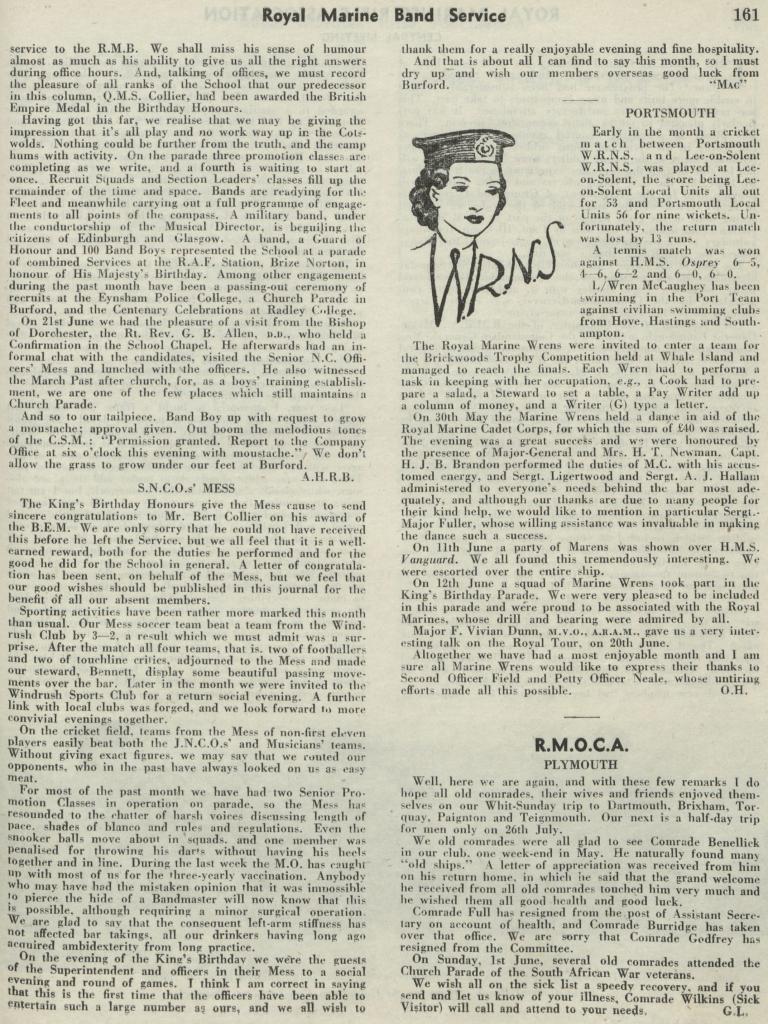
I can confirm that a Royal Marines Band from the Royal Navy School of Music which at the time in 1947 was established in Burford not even five miles away from Brize, attended the air station. This was to provide the music for a combined services parade to celebrate the King's birthday. It also states that there were approx 100 Royal Marines on parade.
I would like to thank everyone who has helped me pinpoint where the photograph was taken. I have no doubt that it is Brize Norton. Many thanks.
I would like to thank everyone who has helped me pinpoint where the photograph was taken. I have no doubt that it is Brize Norton. Many thanks.
Please Log in or Create an account to join the conversation.
- Old Booty
- Topic Author
- Offline
- New Member
-
Less
More
- Posts: 7
- Thank you received: 0
11 Oct 2014 08:07 #13
by Old Booty
Replied by Old Booty on topic Royal Marines on an RAF Parade Ground!!!
The very small entry reference the Kings Birthday Parade at Brize Norton starts on line 17 of the left hand column. This page is from the 1947 July edition of the Globe and Laurel. The reason that the RNSM was in Burford was that in 1940 it was considered that Deal in Kent, which was the school's permanent home was too close to the German forces in France. The School moved and commenced a nomadic existence through the West Country, Worcester, the Isle of Man, Scarborough and Oxfordshire before returning to Deal in 1950. Its home in Gloucestershire was Burford.
Attached files
This image is hidden for guests.
Attached files
This image is hidden for guests.
Please log in or register to see it.
Please Log in or Create an account to join the conversation.
- canberra
- Offline
- Platinum Member
-
Less
More
- Posts: 5639
- Thank you received: 122
11 Oct 2014 10:45 #14
by canberra
Replied by canberra on topic Royal Marines on an RAF Parade Ground!!!
According to Wiki the Royal Marine Band Service lost 225 men in wwii, and that was approx a quarter of its strength. As a percentage only Bomber Command lost more.
Please Log in or Create an account to join the conversation.
- carnaby
-

- Offline
- Platinum Member
-
Less
More
- Posts: 5026
- Thank you received: 440
11 Oct 2014 12:23 #15
by carnaby
This room was considered to be extremely vulnerable and hence was usually buried deep within the ship - the consequence being that if the vessel was severely damaged by enemy action, the occupants had little chance of escape.
archives.chicagotribune.com/1941/12/14/p...y-of-popular-science
Can't remember the source of this information, but it came to light when Paul F and I were writing the Naval report for English Heritage.
Plan A is always more effective when the problem you are working on understands that Plan B will involve the use of dynamite
Replied by carnaby on topic Royal Marines on an RAF Parade Ground!!!
Traditionally musicians tend to have 'mathematical' brains. This was put to good effect in WWII by employing them in the transmitting rooms of warships. This was a British term for the gun control room which contained a number of mechanical computers which analysed the information from the director tower on the ship. It took into effect air temperature, the number of times a gun had been fired, the deviation of barrel elevation as each gun rotated (due to imperfect bearings) and a host of other factors. It was generally reckoned that the third salvo from the ship would hit an enemy which was many miles away.According to Wiki the Royal Marine Band Service lost 225 men in wwii, and that was approx a quarter of its strength.
This room was considered to be extremely vulnerable and hence was usually buried deep within the ship - the consequence being that if the vessel was severely damaged by enemy action, the occupants had little chance of escape.
archives.chicagotribune.com/1941/12/14/p...y-of-popular-science
Can't remember the source of this information, but it came to light when Paul F and I were writing the Naval report for English Heritage.
Plan A is always more effective when the problem you are working on understands that Plan B will involve the use of dynamite
Please Log in or Create an account to join the conversation.
- Old Booty
- Topic Author
- Offline
- New Member
-
Less
More
- Posts: 7
- Thank you received: 0
11 Oct 2014 12:52 #16
by Old Booty
Replied by Old Booty on topic Royal Marines on an RAF Parade Ground!!!
Carnaby, you are absolutely correctsee below:
"For the first part of the 20th century, the Royal Marines' role was the traditional one of providing shipboard infantry for security, boarding parties and small-scale landings. The Marines' other traditional position on a Royal Navy ship was manning 'X' and 'Y' (the aftermost) gun turrets on a battleship or cruiser. During both World War I and World War II Royal Marine detachments were limited to Cruisers and above and until the latter part of the 20th century Royal Marine Bands were also carried on those ships. In times of war the Bandsmen traditionally operated the ship's comprehensive fire-control system, situated for stability and safety at the lowest deck of the ship. Consequently, when ships were sunk, almost inevitably the entire ship's band was lost".
Their role today is different as every musician has a secondary role as a military medic or stretcher bearer.
"For the first part of the 20th century, the Royal Marines' role was the traditional one of providing shipboard infantry for security, boarding parties and small-scale landings. The Marines' other traditional position on a Royal Navy ship was manning 'X' and 'Y' (the aftermost) gun turrets on a battleship or cruiser. During both World War I and World War II Royal Marine detachments were limited to Cruisers and above and until the latter part of the 20th century Royal Marine Bands were also carried on those ships. In times of war the Bandsmen traditionally operated the ship's comprehensive fire-control system, situated for stability and safety at the lowest deck of the ship. Consequently, when ships were sunk, almost inevitably the entire ship's band was lost".
Their role today is different as every musician has a secondary role as a military medic or stretcher bearer.
Please Log in or Create an account to join the conversation.
- Forum
- Open Forum
- Miscellaneous Research Topics
- Where or What is this?
- Royal Marines on an RAF Parade Ground!!!
Time to create page: 0.039 seconds