- Posts: 466
- Thank you received: 2
- Forum
- Open Forum
- Miscellaneous Research Topics
- General Airfield or 20th Century Military Architecture Discussion Topics
- Dispersal Huts
Dispersal Huts
- TommyUSA
-
 Topic Author
- Offline
- Premium Member
-

Less
More
12 Oct 2009 20:15 #1
by TommyUSA
.
Follow my World War II daily tweets at twitter.com/Sept1939
Dispersal Huts was created by TommyUSA
Some questions about Dispersal Huts...
From what I've read, Dispersal Huts were used at Fighter Bases for pilots waiting to scramble on a moment's notice. For what were they used on Bomber and Transport bases?
How large were they? What did they contain? Were they built to a pattern? On the few Site Plans I have, there are no construction types or drawings numbers for these huts. Photographs on the internet run the gamut from Nissen to cantonment-like huts...
Tommy
From what I've read, Dispersal Huts were used at Fighter Bases for pilots waiting to scramble on a moment's notice. For what were they used on Bomber and Transport bases?
How large were they? What did they contain? Were they built to a pattern? On the few Site Plans I have, there are no construction types or drawings numbers for these huts. Photographs on the internet run the gamut from Nissen to cantonment-like huts...
Tommy
.
Follow my World War II daily tweets at twitter.com/Sept1939
Please Log in or Create an account to join the conversation.
- Paul Francis
-

- Offline
- Moderator
-

Less
More
- Posts: 5843
- Thank you received: 567
12 Oct 2009 21:30 #2
by Paul Francis
You can tell a builder from an archaeologist by the size of his trowel. Mine is a small one!
Replied by Paul Francis on topic Dispersal Huts
At the fighter stations, dispersal huts were flight offices, one office per flight along with a toilet block / drying room and an ablutions plus a sleeping shelter to sleep 18 with an additional shelters sleeping 33. This is 1940 as first conceived.
Or looking at it another way twelve fighter pens each having two aircraft making 24 equals one squadron, four flights per squadron, each one having six aircraft (or three sections).
A Flight office was the flight admin HQ and included a store. Typically those at Exeter were TB and 'T'-shaped in plan to drawing 6370/40.
Or looking at it another way twelve fighter pens each having two aircraft making 24 equals one squadron, four flights per squadron, each one having six aircraft (or three sections).
A Flight office was the flight admin HQ and included a store. Typically those at Exeter were TB and 'T'-shaped in plan to drawing 6370/40.
You can tell a builder from an archaeologist by the size of his trowel. Mine is a small one!
Please Log in or Create an account to join the conversation.
- Peter Kirk
-

- Offline
- Moderator
-
Less
More
- Posts: 12446
- Thank you received: 1029
12 Oct 2009 21:38 #3
by Peter Kirk
No Amount Of Evidence Will Ever Persuade An Idiot (probably not Mark Twain)
Replied by Peter Kirk on topic Dispersal Huts
A lot of the duration only bomber bases seemed to have no dispersal facilities judging by the number of packing case sheds that were put together.
I haven't got any true bomber airfield plans so I can't confirm this. If the airfield was designed for a different purpose I suppose they could be present as per a fighter base.
Have you got any eaxamples Tommy?
I haven't got any true bomber airfield plans so I can't confirm this. If the airfield was designed for a different purpose I suppose they could be present as per a fighter base.
Have you got any eaxamples Tommy?
No Amount Of Evidence Will Ever Persuade An Idiot (probably not Mark Twain)
Please Log in or Create an account to join the conversation.
- TommyUSA
-
Topic Author
- Offline
- Premium Member
-
Less
More
- Posts: 466
- Thank you received: 2
13 Oct 2009 02:20 #4
by TommyUSA
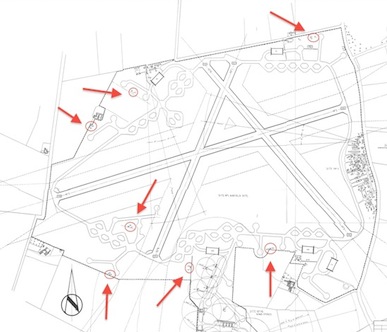
Well... RAF Balderton was a bomber and transport only facility (although I can't be sure that it wasn't envisioned to be a fighter base). It has both frying pan and loops dispersals. See the attached site plan - I've marked the dispersal huts.
Tommy
Attached files
This image is hidden for guests.
.
Follow my World War II daily tweets at twitter.com/Sept1939
Replied by TommyUSA on topic Dispersal Huts
A lot of the duration only bomber bases seemed to have no dispersal facilities judging by the number of packing case sheds that were put together.
I haven't got any true bomber airfield plans so I can't confirm this. If the airfield was designed for a different purpose I suppose they could be present as per a fighter base.
Have you got any examples Tommy?
Well... RAF Balderton was a bomber and transport only facility (although I can't be sure that it wasn't envisioned to be a fighter base). It has both frying pan and loops dispersals. See the attached site plan - I've marked the dispersal huts.
Tommy
Attached files
This image is hidden for guests.
Please log in or register to see it.
.
Follow my World War II daily tweets at twitter.com/Sept1939
Please Log in or Create an account to join the conversation.
- PETERTHEEATER
-

- Offline
- Platinum Member
-

Less
More
- Posts: 10905
- Thank you received: 772
13 Oct 2009 07:45 #5
by PETERTHEEATER
Kimbolton - GP Hut, Temporary Brick and GP Hut Nissen 36'x16'. No drawing number
Ridgewell - Dispersal Hut, Nissen, Drawing Number 9024/41
Chalgrove, GP Hut, Temporary Brick, 30'x18', No drawing number
Stanton Harcourt, GB (?) Hut, Nissen, No drawing number
Nuthampstead, GP Hut, Nissen 36'x16', No drawing number
Dunkeswell.GP Hut, Gerrard, Drawing Number 5773/41 and Handcraft huts, no drawing number.
Bomber aircraft were parked at dispersals and even heavy maintenance such as engine changes were carried out in all weathers. Major work would see them towed to a hangar. So, there was a need to provide Crew Rooms for maintenance men with tool stores etc. In almost all cases a similar hut as a Latrine was provided. At Kimbolton these are shown as Temporary Brick, Drawing Number 9026/41.
Replied by PETERTHEEATER on topic Dispersal Huts
Tommy, taking a quick trawl of some Bomber RSPs shows:Some questions about Dispersal Huts...
From what I've read, Dispersal Huts were used at Fighter Bases for pilots waiting to scramble on a moment's notice. For what were they used on Bomber and Transport bases?
How large were they? What did they contain? Were they built to a pattern? On the few Site Plans I have, there are no construction types or drawings numbers for these huts. Photographs on the internet run the gamut from Nissen to cantonment-like huts...
Tommy
Kimbolton - GP Hut, Temporary Brick and GP Hut Nissen 36'x16'. No drawing number
Ridgewell - Dispersal Hut, Nissen, Drawing Number 9024/41
Chalgrove, GP Hut, Temporary Brick, 30'x18', No drawing number
Stanton Harcourt, GB (?) Hut, Nissen, No drawing number
Nuthampstead, GP Hut, Nissen 36'x16', No drawing number
Dunkeswell.GP Hut, Gerrard, Drawing Number 5773/41 and Handcraft huts, no drawing number.
Bomber aircraft were parked at dispersals and even heavy maintenance such as engine changes were carried out in all weathers. Major work would see them towed to a hangar. So, there was a need to provide Crew Rooms for maintenance men with tool stores etc. In almost all cases a similar hut as a Latrine was provided. At Kimbolton these are shown as Temporary Brick, Drawing Number 9026/41.
Please Log in or Create an account to join the conversation.
- Peter Kirk
-
- Offline
- Moderator
-
Less
More
- Posts: 12446
- Thank you received: 1029
13 Oct 2009 09:52 #6
by Peter Kirk
No Amount Of Evidence Will Ever Persuade An Idiot (probably not Mark Twain)
Replied by Peter Kirk on topic Dispersal Huts
Balderton started as a grass aerodrome roughly square with dispersals around the perimeter. The pans and some of the oddly placed track are the remains of this layout. Maybe earlier builds had them. If dispersal accomodation was prvided at all bases why would they build homemade sheds?
No Amount Of Evidence Will Ever Persuade An Idiot (probably not Mark Twain)
Please Log in or Create an account to join the conversation.
- CDP
- Offline
- Premium Member
-
Less
More
- Posts: 707
- Thank you received: 4
15 Oct 2009 11:27 #7
by CDP
"We either stand down or blow up - which do you want!"
Replied by CDP on topic Dispersal Huts
Although not numbered, there are dispersal huts at RAF Grimsby (Waltham). The remains of one of them is of TB construction.
Chris
Chris
"We either stand down or blow up - which do you want!"
Please Log in or Create an account to join the conversation.
- Paul Francis
-
- Offline
- Moderator
-
Less
More
- Posts: 5843
- Thank you received: 567
15 Oct 2009 16:26 #8
by Paul Francis
You can tell a builder from an archaeologist by the size of his trowel. Mine is a small one!
Replied by Paul Francis on topic Dispersal Huts
We can see from the above posts that dispersal huts cover a multitude of sins from general purpose to anti-aircraft huts with latrine blocks in between.
You can tell a builder from an archaeologist by the size of his trowel. Mine is a small one!
Please Log in or Create an account to join the conversation.
- carnaby
-

- Offline
- Platinum Member
-
Less
More
- Posts: 5026
- Thank you received: 440
23 Oct 2009 10:12 #9
by carnaby
Plan A is always more effective when the problem you are working on understands that Plan B will involve the use of dynamite
Replied by carnaby on topic Dispersal Huts
Interestingly Snitterfield has Seco dispersal huts to a local drawing number SN350. I winder why - what's wrong with a ubiquitous General Purpose hut?
Graham
Graham
Plan A is always more effective when the problem you are working on understands that Plan B will involve the use of dynamite
Please Log in or Create an account to join the conversation.
- PETERTHEEATER
-
- Offline
- Platinum Member
-
Less
More
- Posts: 10905
- Thank you received: 772
30 Oct 2009 06:51 #10
by PETERTHEEATER
Replied by PETERTHEEATER on topic Dispersal Huts
Probably the usual contractor license to procure in lieu items locally if unavailable from AMWD supply?
Please Log in or Create an account to join the conversation.
- Forum
- Open Forum
- Miscellaneous Research Topics
- General Airfield or 20th Century Military Architecture Discussion Topics
- Dispersal Huts
Time to create page: 0.043 seconds