- Posts: 43
- Thank you received: 3
- Forum
- Open Forum
- Miscellaneous Research Topics
- General Airfield or 20th Century Military Architecture Discussion Topics
- Blue Danube arming question
Blue Danube arming question
- ColinA
- Topic Author
- Offline
- Junior Member
-

Less
More
13 Feb 2011 17:32 #1
by ColinA
Blue Danube arming question was created by ColinA
Ok I know this is "Top Secret Atomic" 
But pictures are in the public domain so can anyone shed light for me?
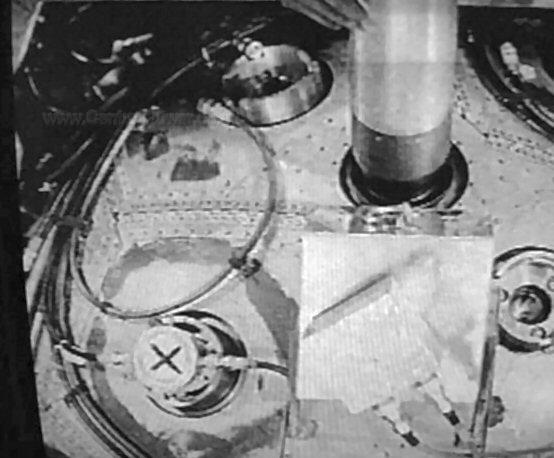
The first picture shows a Blue Danube assembly
This image is hidden for guests.
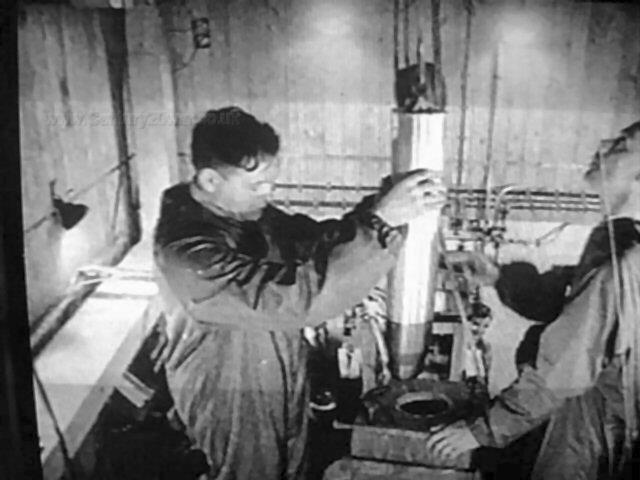
Now we see what appears to be the insertion of the core.
This image is hidden for guests.
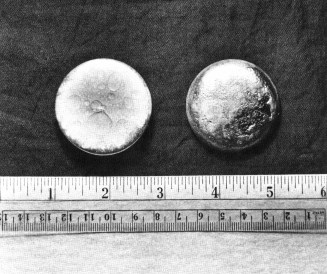
The diameter of an similar American MK3 core is 3.62in
This image is hidden for guests.
So what I am asking?
Is the man using a special tool to insert the core?
There is a concave end at the bottom so does this represent the bottom of the plutonium core?
My understanding was that segments of the explosive lenses were removed first.

But pictures are in the public domain so can anyone shed light for me?
The first picture shows a Blue Danube assembly
This image is hidden for guests.
Please log in or register to see it.
Now we see what appears to be the insertion of the core.
This image is hidden for guests.
Please log in or register to see it.
The diameter of an similar American MK3 core is 3.62in
This image is hidden for guests.
Please log in or register to see it.
So what I am asking?
Is the man using a special tool to insert the core?
There is a concave end at the bottom so does this represent the bottom of the plutonium core?
My understanding was that segments of the explosive lenses were removed first.
Please Log in or Create an account to join the conversation.
- WJT
- Visitor
-

13 Feb 2011 17:51 #2
by WJT
Replied by WJT on topic Blue Danube arming question
That's not the 'funnel' for loading the ball bearings, is it?
Please Log in or Create an account to join the conversation.
- ColinA
- Topic Author
- Offline
- Junior Member
-
Less
More
- Posts: 43
- Thank you received: 3
13 Feb 2011 18:26 #3
by ColinA
Replied by ColinA on topic Blue Danube arming question
Blue danube did not have the ball bearings.
This bomb was a near copy of the US Mk3 with a solid pit.
Our later weapons like green bamboo had a hollow core which required the ballbearings to be "safe"
This bomb was a near copy of the US Mk3 with a solid pit.
Our later weapons like green bamboo had a hollow core which required the ballbearings to be "safe"
Please Log in or Create an account to join the conversation.
- Paul Francis
-

- Offline
- Moderator
-

Less
More
- Posts: 5843
- Thank you received: 567
13 Feb 2011 21:08 #4
by Paul Francis
You can tell a builder from an archaeologist by the size of his trowel. Mine is a small one!
Replied by Paul Francis on topic Blue Danube arming question
Yes that always worried me, in my mind thinking about those ball bearings being accidently spilled and running away, there would always be one that couldn't be found, having rolled under some piece of equipment or worse, down some drain!
It employed the implosion principle and as such had a hollow
sphere of plutonium surrounded by explosives built into the structure which could not be
removed during storage. As a safety device the centre of the fissile casing was filled with steel
balls which prevented a critical state occurring should the implosion system be accidentally
initiated during storage. Provision was made to remove the balls via an access point in the
lowest point of the bomb immediately prior to take-off whilst the weapon was in the aircraft on
the ground. Because of this the weapon was considered to have serious handling problems
and it is unlikely that the fully-assembled weapon was ever given authorisation to be
transported along public roads between Faldingworth and Scampton.
Violet Club had a total weight of 11,250lb in storage (with steel balls) and 10,250lb when
armed.
It employed the implosion principle and as such had a hollow
sphere of plutonium surrounded by explosives built into the structure which could not be
removed during storage. As a safety device the centre of the fissile casing was filled with steel
balls which prevented a critical state occurring should the implosion system be accidentally
initiated during storage. Provision was made to remove the balls via an access point in the
lowest point of the bomb immediately prior to take-off whilst the weapon was in the aircraft on
the ground. Because of this the weapon was considered to have serious handling problems
and it is unlikely that the fully-assembled weapon was ever given authorisation to be
transported along public roads between Faldingworth and Scampton.
Violet Club had a total weight of 11,250lb in storage (with steel balls) and 10,250lb when
armed.
You can tell a builder from an archaeologist by the size of his trowel. Mine is a small one!
Please Log in or Create an account to join the conversation.
- PETERTHEEATER
-
- Offline
- Platinum Member
-

Less
More
- Posts: 10905
- Thank you received: 772
14 Feb 2011 05:17 #5
by PETERTHEEATER
Replied by PETERTHEEATER on topic Blue Danube arming question
The US Mk 3 package had a removable 'pit' for safety and it had to be installed prior to loading or in-flight dependent on aircraft type. The Blue Danube had a number of physics package options ranging from a removable (for safety) 'pit' to a later developed 'sealed pit' - to use US terminology - which could be left in position after installation making the bomb more 'ready for use' although there were other limitations such as battery life.
Yes, there were removable segments,in the HE lenses that surrounded the pit, to enable fitment and removal. Although not having actual experience in this task which was done by AWRE men, the weigh of the sealed pit assembly was considerable and a hoist is being used to lower the device (Image 2) however, I don't think that it is being lowered into a package. The diameter of the package was over 50 inches yet the two men are standing close to the assumed 'pit' assembly. More likely it is being put into or removed from store.
Image 2 appears to show a 'pit' assembly being removed or installed.
From the shape of the 'pit' in both Image 1 and 2 it would appear to be one of the later options maybe even a fusion version with selectable yield.
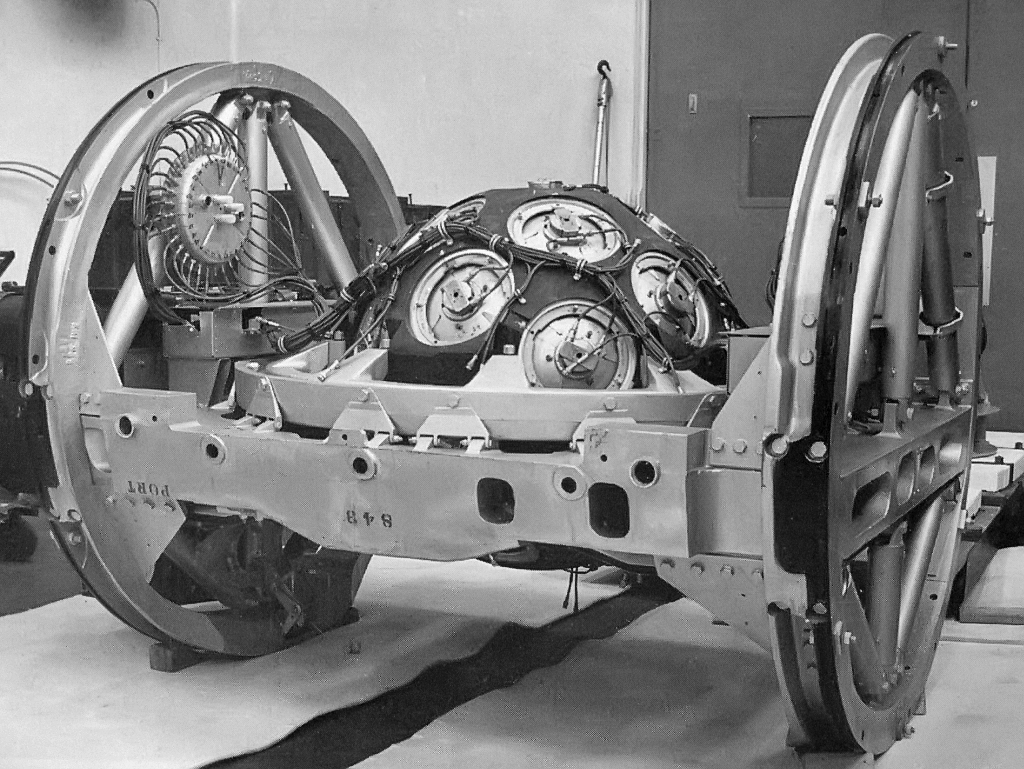
Edit 1 - An interesting point is the length of the firing cables to each detonator. Simultaneous and instantaneous firing of each detonator was critical (no pun intended) to a near perfect implosion of the HE. Consequently, each firing cable was the same length to ensure the same electrical characteristics and the 'spare' cable was clipped out of the way around the sphere in a defined path. Later developments in circuitry (klytrons and all that) did away with that.
Edit 2 - I forgot to make it clear that Blue Danube was the bomb casing and tail unit and as such could be fitted with a variety of physics packages.
Yes, there were removable segments,in the HE lenses that surrounded the pit, to enable fitment and removal. Although not having actual experience in this task which was done by AWRE men, the weigh of the sealed pit assembly was considerable and a hoist is being used to lower the device (Image 2) however, I don't think that it is being lowered into a package. The diameter of the package was over 50 inches yet the two men are standing close to the assumed 'pit' assembly. More likely it is being put into or removed from store.
Image 2 appears to show a 'pit' assembly being removed or installed.
From the shape of the 'pit' in both Image 1 and 2 it would appear to be one of the later options maybe even a fusion version with selectable yield.
Edit 1 - An interesting point is the length of the firing cables to each detonator. Simultaneous and instantaneous firing of each detonator was critical (no pun intended) to a near perfect implosion of the HE. Consequently, each firing cable was the same length to ensure the same electrical characteristics and the 'spare' cable was clipped out of the way around the sphere in a defined path. Later developments in circuitry (klytrons and all that) did away with that.
Edit 2 - I forgot to make it clear that Blue Danube was the bomb casing and tail unit and as such could be fitted with a variety of physics packages.
Please Log in or Create an account to join the conversation.
- PETERTHEEATER
-
- Offline
- Platinum Member
-
Less
More
- Posts: 10905
- Thank you received: 772
16 Feb 2011 07:39 #6
by PETERTHEEATER
Replied by PETERTHEEATER on topic Blue Danube arming question
This purports to be an Orange Herald physics package in frame for installation into a Blue Danube bomb casing.
nuclear-weapons.info/images/OHcropped.jpg
nuclear-weapons.info/images/OHcropped.jpg
Please Log in or Create an account to join the conversation.
- SJT1985
- Offline
- Junior Member
-
Less
More
- Posts: 22
- Thank you received: 1
21 Aug 2013 21:19 #7
by SJT1985
Replied by SJT1985 on topic Blue Danube arming question
I spoke about these very same pictures with a retired Air Commodore who used to be a Junior Equipment Officer at RAF Barnham where they stored and did some maintenance on the Blue Danube.
From his recollections, he seemed to think that the long sleeve was known as a gauntlet with the plutonium core on the end. The core itself was stored independently of the gauntlet in its own case and put in "igloos" at Barnham, Faldingworth or at some of the airfields, such as Wittering. These Igloos were mk4 manifoil lock secured buildings with a floor recess with a metal safe in for housing the weapons.
He said they would never mate the core with the weapon at the storage sites and indeed believed that the core wouldn't be inserted operationally until the aircraft was about to take off, the lack of a core being the only fail safe fitted to the weapon.
Like I say, that's what I was told and I've not got a clue when it comes to nukes so I can't vouch for the accuracy, but it seemed plausible.
From his recollections, he seemed to think that the long sleeve was known as a gauntlet with the plutonium core on the end. The core itself was stored independently of the gauntlet in its own case and put in "igloos" at Barnham, Faldingworth or at some of the airfields, such as Wittering. These Igloos were mk4 manifoil lock secured buildings with a floor recess with a metal safe in for housing the weapons.
He said they would never mate the core with the weapon at the storage sites and indeed believed that the core wouldn't be inserted operationally until the aircraft was about to take off, the lack of a core being the only fail safe fitted to the weapon.
Like I say, that's what I was told and I've not got a clue when it comes to nukes so I can't vouch for the accuracy, but it seemed plausible.
Please Log in or Create an account to join the conversation.
- Alex Brown
- Offline
- Platinum Member
-
Less
More
- Posts: 2418
- Thank you received: 21
21 Aug 2013 21:39 #8
by Alex Brown
Other nuclear storage facilities (including some in the US) apparently made do with the Ingersoll 10 lever key lock system. I wonder why the facilities here required a combination locking system more often used for protecting data, comms and document vaults and areas?
Yes, I'm back(ish).
Replied by Alex Brown on topic Blue Danube arming question
From his recollections, he seemed to think that the long sleeve was known as a gauntlet with the plutonium core on the end. The core itself was stored independently of the gauntlet in its own case and put in "igloos" at Barnham, Faldingworth or at some of the airfields, such as Wittering. These Igloos were mk4 manifoil lock secured buildings with a floor recess with a metal safe in for housing the weapons.
Other nuclear storage facilities (including some in the US) apparently made do with the Ingersoll 10 lever key lock system. I wonder why the facilities here required a combination locking system more often used for protecting data, comms and document vaults and areas?
Yes, I'm back(ish).
Please Log in or Create an account to join the conversation.
- PETERTHEEATER
-
- Offline
- Platinum Member
-
Less
More
- Posts: 10905
- Thank you received: 772
22 Aug 2013 10:06 #9
by PETERTHEEATER
I think it was simply that a key could be stolen and the lock opened illegally whereas the combination required a frequently changed code known only to selected individuals.
Replied by PETERTHEEATER on topic Blue Danube arming question
Other nuclear storage facilities (including some in the US) apparently made do with the Ingersoll 10 lever key lock system. I wonder why the facilities here required a combination locking system more often used for protecting data, comms and document vaults and areas?
I think it was simply that a key could be stolen and the lock opened illegally whereas the combination required a frequently changed code known only to selected individuals.
Please Log in or Create an account to join the conversation.
- Alex Brown
- Offline
- Platinum Member
-
Less
More
- Posts: 2418
- Thank you received: 21
22 Aug 2013 12:57 #10
by Alex Brown
Agreed, but I would imagine that there would be incredibly stringent checks on the number of keys cut, and any then logged out and not returned would instigate the swift changing of that particular lock barrel!
Even if someone managed to make a wax impression of the key, the restricted Ingersoll "M" profile blanks that would probably have been used were nigh on impossible to obtain and so you'd find it difficult to get one to file into shape.
That said I agree that there would still be a marginal risk which would not exist with a regularly changed combination lock.
So it's probable that safe weapons would have been stored under key and only the cores would have been stored under combination? That fits in with the evidence that big igloos had key locks, whereas core hutches had combination locks...
Yes, I'm back(ish).
Replied by Alex Brown on topic Blue Danube arming question
I think it was simply that a key could be stolen and the lock opened illegally whereas the combination required a frequently changed code known only to selected individuals.
Agreed, but I would imagine that there would be incredibly stringent checks on the number of keys cut, and any then logged out and not returned would instigate the swift changing of that particular lock barrel!
Even if someone managed to make a wax impression of the key, the restricted Ingersoll "M" profile blanks that would probably have been used were nigh on impossible to obtain and so you'd find it difficult to get one to file into shape.
That said I agree that there would still be a marginal risk which would not exist with a regularly changed combination lock.
So it's probable that safe weapons would have been stored under key and only the cores would have been stored under combination? That fits in with the evidence that big igloos had key locks, whereas core hutches had combination locks...
Yes, I'm back(ish).
Please Log in or Create an account to join the conversation.
- Forum
- Open Forum
- Miscellaneous Research Topics
- General Airfield or 20th Century Military Architecture Discussion Topics
- Blue Danube arming question
Time to create page: 0.059 seconds