- Posts: 742
- Thank you received: 1
- Forum
- Open Forum
- Miscellaneous Research Topics
- General Airfield or 20th Century Military Architecture Discussion Topics
- Condition of Airfield Buildings
Condition of Airfield Buildings
- YellowPinkie
-

- Offline
- Premium Member
-

Less
More
29 May 2011 07:28 #21
by YellowPinkie
Replied by YellowPinkie on topic Condition of Airfield Buildings
Nicely put, Peter.
Please Log in or Create an account to join the conversation.
- Denis
- Offline
- Elite Member
-

Less
More
- Posts: 1102
- Thank you received: 2
29 May 2011 09:35 #22
by Denis
Replied by Denis on topic Condition of Airfield Buildings
There were also cases of wartime hutting being deliberately cleared by local government to stop squatters use too. local cases here being Matching and Sawbridgeworth, where squatting levels were becoming a problem with displaced persons forming quite strong communities.
These were also dispersed sites and originally built on requiisitioned farmland, no doubt the local authorities clearance of these sites only preceeded the landowners intentions by a few months in any case!
These were also dispersed sites and originally built on requiisitioned farmland, no doubt the local authorities clearance of these sites only preceeded the landowners intentions by a few months in any case!
Please Log in or Create an account to join the conversation.
- PETERTHEEATER
-

- Offline
- Platinum Member
-

Less
More
- Posts: 10905
- Thank you received: 772
30 May 2011 08:24 #23
by PETERTHEEATER
Replied by PETERTHEEATER on topic Condition of Airfield Buildings
To demonstrate longevity, I was very happy to see that the British Army, having seriously modified much of Bassingbourn airfield, recognised the build quality of these two Danger Buildings and spent a modest amount of money in refurbishing and securing them.
wtp2.appspot.com/wheresthepath.htm?lat=5...4404&gz=18&oz=8>=1
wtp2.appspot.com/wheresthepath.htm?lat=5...4404&gz=18&oz=8>=1
Please Log in or Create an account to join the conversation.
- canberra
- Offline
- Platinum Member
-
Less
More
- Posts: 5639
- Thank you received: 122
30 May 2011 11:48 #24
by canberra
Replied by canberra on topic Condition of Airfield Buildings
As they appear to have a fence round them Im guessing that theyre still being used for explosive storage.
Please Log in or Create an account to join the conversation.
- PETERTHEEATER
-
- Offline
- Platinum Member
-
Less
More
- Posts: 10905
- Thank you received: 772
31 May 2011 07:43 #25
by PETERTHEEATER
Replied by PETERTHEEATER on topic Condition of Airfield Buildings
Without a doubt.
Please Log in or Create an account to join the conversation.
- Doering
- Topic Author
- Offline
- Junior Member
-

Less
More
- Posts: 37
- Thank you received: 0
31 May 2011 13:10 #26
by Doering
Replied by Doering on topic Condition of Airfield Buildings
Paul and others,
Just for information, this is an additional quote over on the other forum:
"Thank you for the reply, and your effort to come back on the different subjects.
Archeology:
Yes, a lot was found, and quickly investigated. But it could not be done in the proper way because the airstrips had to be made asap. Positive is that because of those surface excavations, so much was found on places where nobody would look otherwise. And is not so bad that some soil and concrete is poured over it to a depth of +- 1 meter ( ) It keeps scavengers away. The redundant airfields will probably undergo indepth archeological investigations afterwards.
Quality: it is a known fact that many wooden barracks were made of wood that had not dried long enough ( no time ) and was not well treated. ( lack of the right material )
Concrete building and contractors: yes, there are stories about private contractors who cheated by purpose. But others did it wrong because of lack of knowledge.
Just a small detail: my late grandfather who was a forced labourer on the Atlantikwall told stories how they sabotaged the work by messing with the right mix of the concrete.
But this is something that British labourers never would have done on their own construction sites.
I don't know if German/Italian POW's were involved in the construction of those airfields."
He does seem very knowledgeable and sincere.
Just for information, this is an additional quote over on the other forum:
"Thank you for the reply, and your effort to come back on the different subjects.
Archeology:
Yes, a lot was found, and quickly investigated. But it could not be done in the proper way because the airstrips had to be made asap. Positive is that because of those surface excavations, so much was found on places where nobody would look otherwise. And is not so bad that some soil and concrete is poured over it to a depth of +- 1 meter ( ) It keeps scavengers away. The redundant airfields will probably undergo indepth archeological investigations afterwards.
Quality: it is a known fact that many wooden barracks were made of wood that had not dried long enough ( no time ) and was not well treated. ( lack of the right material )
Concrete building and contractors: yes, there are stories about private contractors who cheated by purpose. But others did it wrong because of lack of knowledge.
Just a small detail: my late grandfather who was a forced labourer on the Atlantikwall told stories how they sabotaged the work by messing with the right mix of the concrete.
But this is something that British labourers never would have done on their own construction sites.
I don't know if German/Italian POW's were involved in the construction of those airfields."
He does seem very knowledgeable and sincere.
Please Log in or Create an account to join the conversation.
- Gypsymoth
- Offline
- Senior Member
-

Less
More
- Posts: 255
- Thank you received: 1
20 Jun 2011 13:19 #27
by Gypsymoth
Replied by Gypsymoth on topic Condition of Airfield Buildings
From what I've seen during my various rambles, I have the idea that WW2 buildings were built to a high standard - at least not inferior to what folks would have expected or was specified.
As long as the roof is in good condition they'd last for 700 yrs not the 70 they have until now. The red brick buildings I found at Wath Head SLG (eg) in Cumbria were of superb quality.
Expansion buildings are another matter but again all they need is a good roof to keep them in A1 condition.
As long as the roof is in good condition they'd last for 700 yrs not the 70 they have until now. The red brick buildings I found at Wath Head SLG (eg) in Cumbria were of superb quality.
Expansion buildings are another matter but again all they need is a good roof to keep them in A1 condition.
Please Log in or Create an account to join the conversation.
- Richard Drew
-

- Offline
- Elite Member
-
Less
More
- Posts: 1181
- Thank you received: 13
20 Jun 2011 15:00 #28
by Richard Drew
Richard
www.atlantikwall.co.uk
Replied by Richard Drew on topic Condition of Airfield Buildings
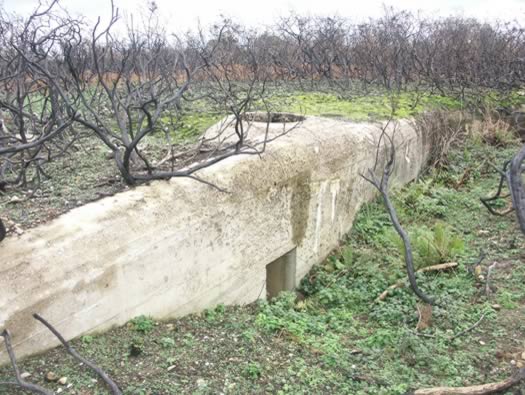
Although they say a lot of sabotage was carried out on the Atlantikwall I have never seen any, most of the bunkers I have seen are as good now as they were when they were finished.
This image is hidden for guests.
This one was burnt in recent scrub fires and looking close up it looks as new. www.atlantikwall.co.uk/atlantikwall/fran...ck10/html/page03.htm This one is above Cherbourg At defensive position of Ostech a large radar site. But I herd that on V1 sites that had to be free from any metal so that their compass could be set that the forced labour did drop nails into the mix but if court they would have been shot.
Richard
This image is hidden for guests.
Please log in or register to see it.
This one was burnt in recent scrub fires and looking close up it looks as new. www.atlantikwall.co.uk/atlantikwall/fran...ck10/html/page03.htm This one is above Cherbourg At defensive position of Ostech a large radar site. But I herd that on V1 sites that had to be free from any metal so that their compass could be set that the forced labour did drop nails into the mix but if court they would have been shot.
Richard
Richard
www.atlantikwall.co.uk
Please Log in or Create an account to join the conversation.
- Forum
- Open Forum
- Miscellaneous Research Topics
- General Airfield or 20th Century Military Architecture Discussion Topics
- Condition of Airfield Buildings
Time to create page: 0.050 seconds