- Posts: 10905
- Thank you received: 772
- Forum
- Open Forum
- Miscellaneous Research Topics
- General Airfield or 20th Century Military Architecture Discussion Topics
- Quadrant sight
Quadrant sight
- PETERTHEEATER
-
 Topic Author
- Offline
- Platinum Member
-

Less
More
29 Jan 2010 08:48 #1
by PETERTHEEATER
Quadrant sight was created by PETERTHEEATER
If you try to find an image of a Quadrant Sight via your browser you will probably find nothing!
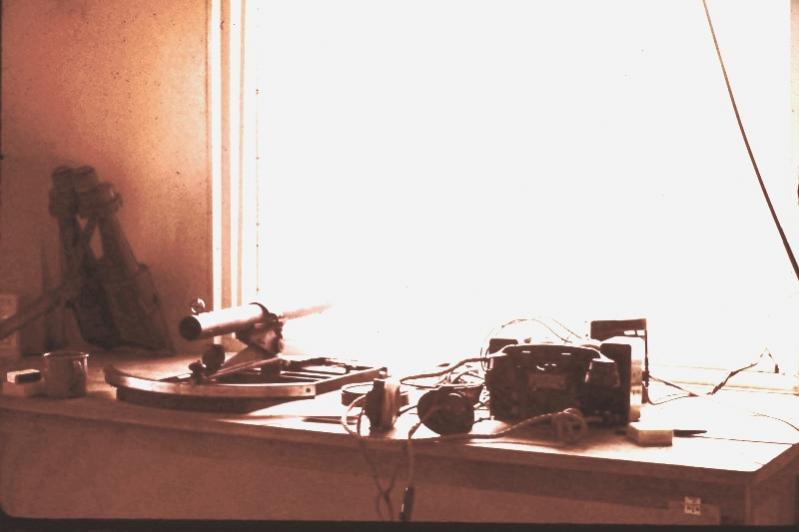
Although my picture below, taken in the Quadrant Shelter on Pulau Tilor (Song Song Range, Malaya) island in 1962 is grotty you should be able to see the main components:
This image is hidden for guests.
The tube on top is not a telescope but has a ring and bead sight. The tube is pivoted and the black knob is used to swing it through an arc of up to 90 degrees.
The name 'quadrant' comes from the base frame which is shaped in an arc and to which is attached a graduated brass scale which reads from zero in the centre up to 45 degrees left or right. The base frame is installed so that when the sight is at zero it points at the target. A built-in spirit bubble enable the frame to be set level with adjusting screws.
In use, the operator watches for a bomb burst then swings the sight to align with the centre of the observed burst. The angle of the sight is then read off the scale as (for example) '16 Left' or '28' Right' which plot is passed to the Master Quadrant Shelter by telephone or radio. A second sight in the Master QS records the same burst. Thus, two readings are taken and used to plot the position of a bomb burst on a large scale diagram of the bombing area. By simple triangulation at the point the two lines cross it is possible to use a protractor to quickly determine the angle and distance from the target. This was then passed to the attack aircraft as (example) ' Your last bomb - 125 feet at 2 o'clock'
It was not unusual for bombs to fall out of the 'plot' due to release error and, even if seen would be reported as 'Your last bomb not observed'
In an effort to placate aircrew who would winge that their bomb was closer than that, our sight were modified by mounting a redundant Mk 3 Reflector Sight (aircraft) on top of the tube. This was successful since it projected a 'graticule' at infinity which for quicker and more accurate sighting.
Although my picture below, taken in the Quadrant Shelter on Pulau Tilor (Song Song Range, Malaya) island in 1962 is grotty you should be able to see the main components:
This image is hidden for guests.
Please log in or register to see it.
The tube on top is not a telescope but has a ring and bead sight. The tube is pivoted and the black knob is used to swing it through an arc of up to 90 degrees.
The name 'quadrant' comes from the base frame which is shaped in an arc and to which is attached a graduated brass scale which reads from zero in the centre up to 45 degrees left or right. The base frame is installed so that when the sight is at zero it points at the target. A built-in spirit bubble enable the frame to be set level with adjusting screws.
In use, the operator watches for a bomb burst then swings the sight to align with the centre of the observed burst. The angle of the sight is then read off the scale as (for example) '16 Left' or '28' Right' which plot is passed to the Master Quadrant Shelter by telephone or radio. A second sight in the Master QS records the same burst. Thus, two readings are taken and used to plot the position of a bomb burst on a large scale diagram of the bombing area. By simple triangulation at the point the two lines cross it is possible to use a protractor to quickly determine the angle and distance from the target. This was then passed to the attack aircraft as (example) ' Your last bomb - 125 feet at 2 o'clock'
It was not unusual for bombs to fall out of the 'plot' due to release error and, even if seen would be reported as 'Your last bomb not observed'
In an effort to placate aircrew who would winge that their bomb was closer than that, our sight were modified by mounting a redundant Mk 3 Reflector Sight (aircraft) on top of the tube. This was successful since it projected a 'graticule' at infinity which for quicker and more accurate sighting.
Please Log in or Create an account to join the conversation.
- Peter Kirk
-

- Offline
- Moderator
-

Less
More
- Posts: 12446
- Thank you received: 1029
29 Jan 2010 10:48 #2
by Peter Kirk
No Amount Of Evidence Will Ever Persuade An Idiot (probably not Mark Twain)
Replied by Peter Kirk on topic Quadrant sight
My first thought was that everything looked low tech for 1962 but then again why not if it works.
As you say, you can't find pics on the web.... until now.
Is that a large binocular on a pole in the corner?
As you say, you can't find pics on the web.... until now.
Is that a large binocular on a pole in the corner?
No Amount Of Evidence Will Ever Persuade An Idiot (probably not Mark Twain)
Please Log in or Create an account to join the conversation.
- Paul Francis
-

- Offline
- Moderator
-
Less
More
- Posts: 5843
- Thank you received: 567
29 Jan 2010 13:35 #3
by Paul Francis
You can tell a builder from an archaeologist by the size of his trowel. Mine is a small one!
Replied by Paul Francis on topic Quadrant sight
Had a quick go at lightening the image peter hope you dont mind
Attached files
This image is hidden for guests.
Attached files
This image is hidden for guests.
Please log in or register to see it.
You can tell a builder from an archaeologist by the size of his trowel. Mine is a small one!
Please Log in or Create an account to join the conversation.
- PETERTHEEATER
-
Topic Author
- Offline
- Platinum Member
-
Less
More
- Posts: 10905
- Thank you received: 772
30 Jan 2010 05:25 #4
by PETERTHEEATER
The simple solution always prevails! But, like I say, a few months after I took that pic we did a 'Command Modification) which installed a reflector sight on top of the tube.
Now that Paul has lightened the image I too can see the object in the left corner which was a huge pair of Ross military binoculars of around 20 power with swing-in filters circa 1942. But, they were no really usable due to an internal fungus attack on lenses or prisms which made for crappy viewing.
Also on the table - apart from fags, matches, ashtray and tea mug - is a Field Telephone which means the photo was taken in the Song Song South Quadrant, not the Tilor Quadrant since there was no-one to connect to! Radio only.
Replied by PETERTHEEATER on topic Quadrant sight
My first thought was that everything looked low tech for 1962 but then again why not if it works.
As you say, you can't find pics on the web.... until now.
Is that a large binocular on a pole in the corner?
The simple solution always prevails! But, like I say, a few months after I took that pic we did a 'Command Modification) which installed a reflector sight on top of the tube.
Now that Paul has lightened the image I too can see the object in the left corner which was a huge pair of Ross military binoculars of around 20 power with swing-in filters circa 1942. But, they were no really usable due to an internal fungus attack on lenses or prisms which made for crappy viewing.
Also on the table - apart from fags, matches, ashtray and tea mug - is a Field Telephone which means the photo was taken in the Song Song South Quadrant, not the Tilor Quadrant since there was no-one to connect to! Radio only.
Please Log in or Create an account to join the conversation.
- PETERTHEEATER
-
Topic Author
- Offline
- Platinum Member
-
Less
More
- Posts: 10905
- Thank you received: 772
30 Jan 2010 05:26 #5
by PETERTHEEATER
Replied by PETERTHEEATER on topic Quadrant sight
Thanks Paul for the 'lightening'. I tried it in Picasa but settled for the original.
Please Log in or Create an account to join the conversation.
- PETERTHEEATER
-
Topic Author
- Offline
- Platinum Member
-
Less
More
- Posts: 10905
- Thank you received: 772
25 Oct 2010 07:52 #6
by PETERTHEEATER
Replied by PETERTHEEATER on topic Quadrant sight
Same thing in monochrome.
This image is hidden for guests.
This image is hidden for guests.
Please log in or register to see it.
Please Log in or Create an account to join the conversation.
- Peter Kirk
-
- Offline
- Moderator
-
Less
More
- Posts: 12446
- Thank you received: 1029
25 Oct 2010 11:51 #7
by Peter Kirk
No Amount Of Evidence Will Ever Persuade An Idiot (probably not Mark Twain)
Replied by Peter Kirk on topic Quadrant sight
I did another search on the web and it leads to this page! Sadly most searches on bombing range related items lead to posts on AiX.
No Amount Of Evidence Will Ever Persuade An Idiot (probably not Mark Twain)
Please Log in or Create an account to join the conversation.
- carnaby
-

- Offline
- Platinum Member
-
Less
More
- Posts: 5026
- Thank you received: 440
25 Oct 2010 14:34 #8
by carnaby
Graham
Plan A is always more effective when the problem you are working on understands that Plan B will involve the use of dynamite
Replied by carnaby on topic Quadrant sight
Says a lot for AiX though :cool:ISadly most searches on bombing range related items lead to posts on AiX.
Graham
Plan A is always more effective when the problem you are working on understands that Plan B will involve the use of dynamite
Please Log in or Create an account to join the conversation.
- Peter Kirk
-
- Offline
- Moderator
-
Less
More
- Posts: 12446
- Thank you received: 1029
25 Oct 2010 15:29 #9
by Peter Kirk
No Amount Of Evidence Will Ever Persuade An Idiot (probably not Mark Twain)
Replied by Peter Kirk on topic Quadrant sight
This is my idea of a perfect page. Three pictures, two of which I never thought I would find online, a Hills mirror and a Quadrant sight.
www.flightglobal.com/pdfarchive/view/1944/1944%20-%200250.html
Shame you can't get hold of the originals as there is a wealth of useful photos in Flight.
www.flightglobal.com/pdfarchive/view/1944/1944%20-%200250.html
Shame you can't get hold of the originals as there is a wealth of useful photos in Flight.
No Amount Of Evidence Will Ever Persuade An Idiot (probably not Mark Twain)
Please Log in or Create an account to join the conversation.
- canberra
- Offline
- Platinum Member
-
Less
More
- Posts: 5639
- Thank you received: 122
25 Oct 2010 18:37 #10
by canberra
Replied by canberra on topic Quadrant sight
Our sights at Tain(and I guess the other ranges) had a pair of binocualrs mounted on the top. And we had a fibre optic "gizmo" to the right which gave the angle of the bomb burst.
Please Log in or Create an account to join the conversation.
- Forum
- Open Forum
- Miscellaneous Research Topics
- General Airfield or 20th Century Military Architecture Discussion Topics
- Quadrant sight
Time to create page: 0.059 seconds