- Posts: 9794
- Thank you received: 652
- Forum
- Open Forum
- Miscellaneous Research Topics
- Flight Sim Scenery Design and Scale Modelling
- Airfield 1/72 scale modelling
Airfield 1/72 scale modelling
- REF
-

- Offline
- Platinum Member
-

Less
More
10 Apr 2010 16:13 #51
by REF
Replied by REF on topic Airfield 1/72 scale modelling
Looks great - I hope the inside is as good as the outside!!!!! 
Please Log in or Create an account to join the conversation.
- mitrovitchp
-
- Offline
- Senior Member
-

Less
More
- Posts: 282
- Thank you received: 3
10 Apr 2010 19:53 #52
by mitrovitchp
Replied by mitrovitchp on topic Airfield 1/72 scale modelling
One day I will get these onto a diorama! but for the time being they will have to make do with white card......
All vehicles 1/76 scale;
This image is hidden for guests.
This image is hidden for guests.
This image is hidden for guests.
This image is hidden for guests.
This image is hidden for guests.
Some Royal Navy Ground Equipment (1/72 scale);
This image is hidden for guests.
Some Tornado Ground Equipment (1/72 Scale);
This image is hidden for guests.
This image is hidden for guests.
All vehicles 1/76 scale;
This image is hidden for guests.
Please log in or register to see it.
This image is hidden for guests.
Please log in or register to see it.
This image is hidden for guests.
Please log in or register to see it.
This image is hidden for guests.
Please log in or register to see it.
This image is hidden for guests.
Please log in or register to see it.
Some Royal Navy Ground Equipment (1/72 scale);
This image is hidden for guests.
Please log in or register to see it.
Some Tornado Ground Equipment (1/72 Scale);
This image is hidden for guests.
Please log in or register to see it.
This image is hidden for guests.
Please log in or register to see it.
Please Log in or Create an account to join the conversation.
- ted angus
- Offline
- Platinum Member
-
Less
More
- Posts: 1643
- Thank you received: 51
11 Apr 2010 09:04 #53
by ted angus
Replied by ted angus on topic Airfield 1/72 scale modelling
AWESOME !!!!!!!!
WE thats the royal we had some of the self propelled jobs, but like everything else the squadron guys couldn't be trusted with them; I think they may have all gone to the Navy just after gulf war 1. The 48Kws are being recycled for Typoon . As for the rest of the Typhoon kit I havent seen any but 6 are due here in a few months I will get a shoot done.
TED
WE thats the royal we had some of the self propelled jobs, but like everything else the squadron guys couldn't be trusted with them; I think they may have all gone to the Navy just after gulf war 1. The 48Kws are being recycled for Typoon . As for the rest of the Typhoon kit I havent seen any but 6 are due here in a few months I will get a shoot done.
TED
Please Log in or Create an account to join the conversation.
- Able Mabel
- Offline
- Premium Member
-

Less
More
- Posts: 528
- Thank you received: 31
17 Apr 2010 10:58 #54
by Able Mabel
Replied by Able Mabel on topic Airfield 1/72 scale modelling
As a readily available kit, i thought this Link may be of interest to those who thought about improving the basic kit ..
www.arcforums.com/forums/air/index.php?showtopic=200882&st=120
.
Please Log in or Create an account to join the conversation.
- ted angus
- Offline
- Platinum Member
-
Less
More
- Posts: 1643
- Thank you received: 51
28 Apr 2010 15:48 #55
by ted angus
Replied by ted angus on topic Airfield 1/72 scale modelling
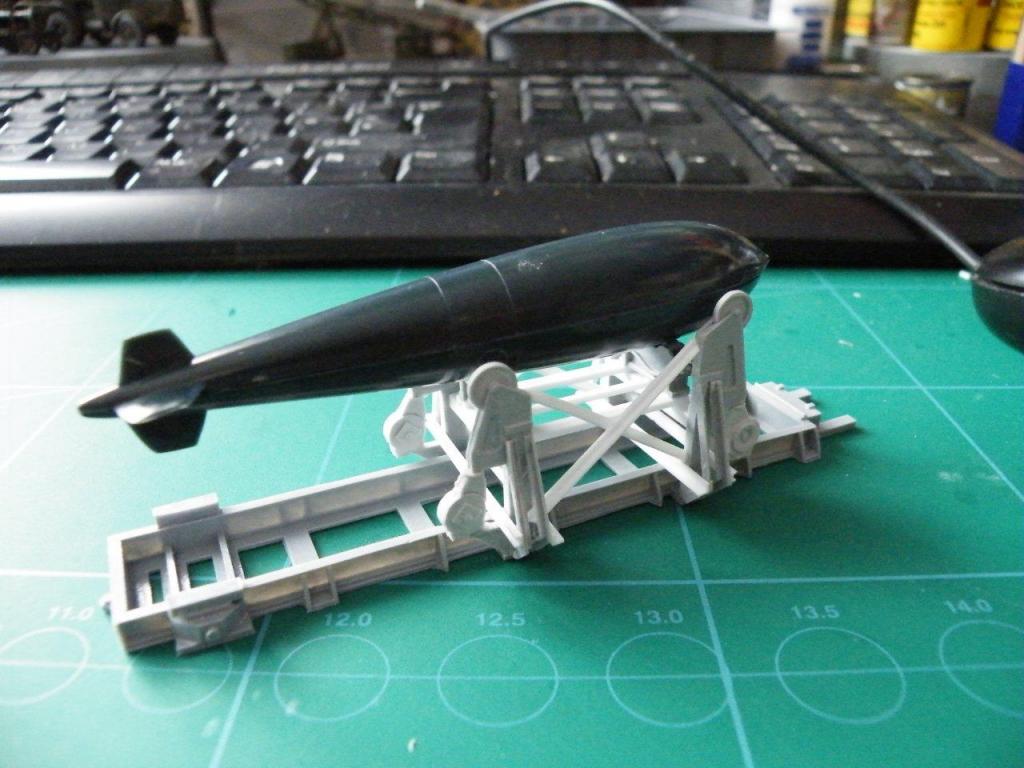
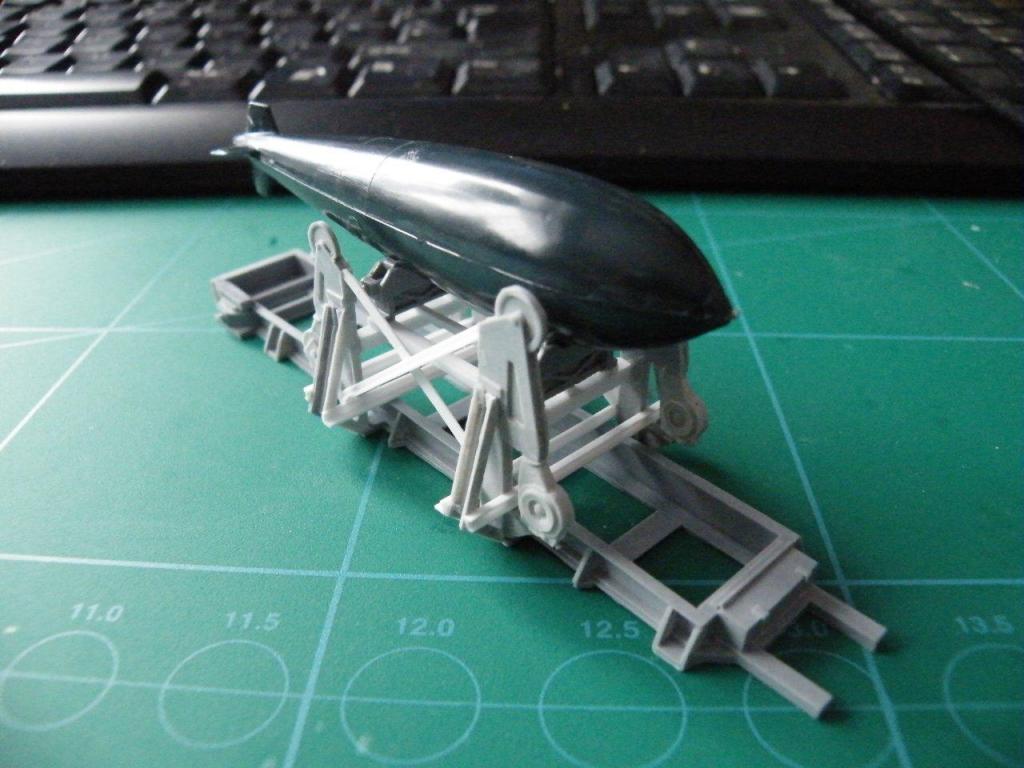
Been getting to grips with the 1/72 Belcher Tallboy/Grandslam trolley; It has been a real battle, the main frame was badly twisted so it spent an afternoon in a bowls of hot water clamped to a steel rule. several different plaastic extrusions are supplied to complete the framework, but of 2 types there isn't enough to complete the frame work, luckily my box of plastic came to the rescue. That said the model is coming on well and I believe is good value . Thanks to Ian ( Able ) I have a Tallboy to show on it. I think i am going to paint the tail natural aluminium various sites give interior grey green, sky, and others natural; I read on a site they were not painted - posted by a former armourer who stated he worked on them ???
CURRENT GSE/MT colours
Had quick word with the paint shop at Leuchars re current colours:
MT /GSE on tactical units Matt IRR or non IRR Green BSC 285. e.g. Harrier force and RAF regt. TMW, TCW, TSW, Some 2MT Sqn.
MT /GSE on non Tactical units gloss green BSC 241 e.g. Leuchars, Coningsby, Lossie, Brize, Waddington. some 2MT Sqn.
That said there is GSE here in both finishes and airfield use only vehicles are being procured in Gloss Golden Yellow.
I think I mentioned the whole RAF there LOL.
TED
Attached files
This image is hidden for guests.
This image is hidden for guests.
CURRENT GSE/MT colours
Had quick word with the paint shop at Leuchars re current colours:
MT /GSE on tactical units Matt IRR or non IRR Green BSC 285. e.g. Harrier force and RAF regt. TMW, TCW, TSW, Some 2MT Sqn.
MT /GSE on non Tactical units gloss green BSC 241 e.g. Leuchars, Coningsby, Lossie, Brize, Waddington. some 2MT Sqn.
That said there is GSE here in both finishes and airfield use only vehicles are being procured in Gloss Golden Yellow.
I think I mentioned the whole RAF there LOL.
TED
Attached files
This image is hidden for guests.
Please log in or register to see it.
This image is hidden for guests.
Please log in or register to see it.
Please Log in or Create an account to join the conversation.
- PETERTHEEATER
-
- Offline
- Platinum Member
-
Less
More
- Posts: 10905
- Thank you received: 772
29 Apr 2010 09:17 #56
by PETERTHEEATER
Replied by PETERTHEEATER on topic Airfield 1/72 scale modelling
Ted, Richard Drew recently asked me about the colour scheme used on WW2 bomb trollies. I could't give a definite reply because I think that there was a pre-war colour scheme which ran over into early war.
Was it RAF Blue/Grey then or something else. Modellers to the rescue!
EDIT:
I'm a large flying scale scratch builder myself. Here's my instrument panel for a long term project, a 1/7 scale Curtiss SC-1
This image is hidden for guests.
Was it RAF Blue/Grey then or something else. Modellers to the rescue!
EDIT:
I'm a large flying scale scratch builder myself. Here's my instrument panel for a long term project, a 1/7 scale Curtiss SC-1
This image is hidden for guests.
Please log in or register to see it.
Please Log in or Create an account to join the conversation.
- ted angus
- Offline
- Platinum Member
-
Less
More
- Posts: 1643
- Thank you received: 51
29 Apr 2010 14:39 #57
by ted angus
Replied by ted angus on topic Airfield 1/72 scale modelling
Hi Peter, All the evidence I have found is that GSE [as we now call it] was until 1947-8 the same colour as MT. So pre war RAF Blue grey, then subsequently the various cam schemes as they came into being. photographic evidence shows bomb trollies in a single colour this would be the base colour of the then current Cam scheme. I now have evidence of Cam painting starting before war was actually declared. Bomb trollies would have a colour strip indicating the owner Sqn. station Commanders were required to allocate a colour to each Sqn to ID its equipment. Also the 2 digit Sqn code was often stencilled on trollies. Overseas this code was also applied to the doors of MT vehicles. By the time the AMO A618/41 (august 1941) was published stating all MT to be Cam, I doubt if much was actually still in RAF Blue Grey.
I also have a preceding AMO, AMO N629/41 ( june 1941) which clarifies the Cam painting of impressed vehicles . As with actions called for in DCIs in later years, most new policy in AMOs would have been given earlier distribution by a Directing Letter or if urgent by telex/signal. Evidence from files at Kew is that the RAF used the same colours from 1939 as the Army, but there there are no AMOs between 1937 and Aug 1941 on the subject.
Peter et Al does anyone know the difference between an A series AMO and an N series. I sent a question to Hendon about 8 weeks ago but no reply ??
I have found a picture of a Grand Slam with one of the access ports in the tail open, on the area the port cover would obscure is a much brighter circle than the rest of the tail, so I have to conclude that the tail was painted, and that the bright circle is bare Ali which had been masked by the access cover during painting ??
That Dash board is great how long term is this project ??
TED
I also have a preceding AMO, AMO N629/41 ( june 1941) which clarifies the Cam painting of impressed vehicles . As with actions called for in DCIs in later years, most new policy in AMOs would have been given earlier distribution by a Directing Letter or if urgent by telex/signal. Evidence from files at Kew is that the RAF used the same colours from 1939 as the Army, but there there are no AMOs between 1937 and Aug 1941 on the subject.
Peter et Al does anyone know the difference between an A series AMO and an N series. I sent a question to Hendon about 8 weeks ago but no reply ??
I have found a picture of a Grand Slam with one of the access ports in the tail open, on the area the port cover would obscure is a much brighter circle than the rest of the tail, so I have to conclude that the tail was painted, and that the bright circle is bare Ali which had been masked by the access cover during painting ??
That Dash board is great how long term is this project ??
TED
Please Log in or Create an account to join the conversation.
- PETERTHEEATER
-
- Offline
- Platinum Member
-
Less
More
- Posts: 10905
- Thank you received: 772
30 Apr 2010 07:07 #58
by PETERTHEEATER
Replied by PETERTHEEATER on topic Airfield 1/72 scale modelling
Hmm.Thank for the comprehensive reply Ted; seems that paint schemes were a little more complicated than I thought. The next question is what were the actual CAM colours?
I know the difference between AMOs 'A' and 'N' but, like you, it is locked in the memory cells and wont come to the fore! I shall endeavor to find out from my contacts.
Re the Grand Slam tail unit access panels. Your surmise is correct. The TUs were spray finished with the panels closed hence the circumference of the aperture was masked and would show bare metal when opened.
My Curtiss SC-1 project has main float, tip floats, wing centre section, tailplane, fin & rudder complete ready for finishing, just outer wing panels and the whole fuselage to go. I estimate another ten years should do it!
I know the difference between AMOs 'A' and 'N' but, like you, it is locked in the memory cells and wont come to the fore! I shall endeavor to find out from my contacts.
Re the Grand Slam tail unit access panels. Your surmise is correct. The TUs were spray finished with the panels closed hence the circumference of the aperture was masked and would show bare metal when opened.
My Curtiss SC-1 project has main float, tip floats, wing centre section, tailplane, fin & rudder complete ready for finishing, just outer wing panels and the whole fuselage to go. I estimate another ten years should do it!
Please Log in or Create an account to join the conversation.
- ted angus
- Offline
- Platinum Member
-
Less
More
- Posts: 1643
- Thank you received: 51
30 Apr 2010 15:36 #59
by ted angus
Replied by ted angus on topic Airfield 1/72 scale modelling
Peter, have a look back at my message No 22. In addition- from Aug 1939 until the first AMO on the subject was issued from Kew documents I am very confident we just copied the Army and used Khaki Green No 3 as the base colour with either Nobels dark tarmac green, dark green No5 or Light green No4 as the disruptive colour.
bomb trollies and the majority of other items of ground euipment would have just been in the relevant base colour, items were only repainted when absolutely necessary
i.e. 1939 onward Khaki Green No 3
from late 1942 Brown Special to SCC2
then from early 1944 UK Olive Drab SCC No 14.
There is a firm in UK called White Ensign Models they do all 3 colours; however the feeling is the SCC2 is not very accurate so I mix my own from a formula. Let me know if you want more detail
TED
bomb trollies and the majority of other items of ground euipment would have just been in the relevant base colour, items were only repainted when absolutely necessary
i.e. 1939 onward Khaki Green No 3
from late 1942 Brown Special to SCC2
then from early 1944 UK Olive Drab SCC No 14.
There is a firm in UK called White Ensign Models they do all 3 colours; however the feeling is the SCC2 is not very accurate so I mix my own from a formula. Let me know if you want more detail
TED
Please Log in or Create an account to join the conversation.
- PETERTHEEATER
-
- Offline
- Platinum Member
-
Less
More
- Posts: 10905
- Thank you received: 772
01 May 2010 09:37 #60
by PETERTHEEATER
Replied by PETERTHEEATER on topic Airfield 1/72 scale modelling
Thanks for that Ted; I have relayed your message to Richard Drew who is assisting an artist who is painting a depiction of work in a WW2 airfield Bomb Store so need to get the details right! I shall also amend my personal notes.
Please Log in or Create an account to join the conversation.
- Forum
- Open Forum
- Miscellaneous Research Topics
- Flight Sim Scenery Design and Scale Modelling
- Airfield 1/72 scale modelling
Time to create page: 0.060 seconds