- Posts: 5383
- Thank you received: 603
- Forum
- Open Forum
- Miscellaneous Research Topics
- Flight Sim Scenery Design and Scale Modelling
- Airfield 1/72 scale modelling
Airfield 1/72 scale modelling
- airfields man
-

- Offline
- Platinum Member
-

Less
More
20 Jun 2010 18:25 #71
by airfields man
This image is hidden for guests.
This image is hidden for guests.
This image is hidden for guests.
This image is hidden for guests.
This image is hidden for guests.
The Dead got memorials, The living got time.
Replied by airfields man on topic Airfield 1/72 scale modelling
This image is hidden for guests.
Please log in or register to see it.
This image is hidden for guests.
Please log in or register to see it.
This image is hidden for guests.
Please log in or register to see it.
This image is hidden for guests.
Please log in or register to see it.
This image is hidden for guests.
Please log in or register to see it.
The Dead got memorials, The living got time.
Please Log in or Create an account to join the conversation.
- PETERTHEEATER
-
- Offline
- Platinum Member
-
Less
More
- Posts: 10905
- Thank you received: 772
21 Jun 2010 09:12 #72
by PETERTHEEATER
Replied by PETERTHEEATER on topic Airfield 1/72 scale modelling
Nice work airfieldsman. Where do you keep 'em all, who does the dusting!?
Please Log in or Create an account to join the conversation.
- airfields man
-
- Offline
- Platinum Member
-
Less
More
- Posts: 5383
- Thank you received: 603
21 Jun 2010 14:50 #73
by airfields man
This image is hidden for guests.
Thankyou Peter, just wish that I had more of 'em. Sadly only the one which is within it's own perspex cover...so thankfully no dust !!
The Dead got memorials, The living got time.
Replied by airfields man on topic Airfield 1/72 scale modelling
This image is hidden for guests.
Please log in or register to see it.
Thankyou Peter, just wish that I had more of 'em. Sadly only the one which is within it's own perspex cover...so thankfully no dust !!
The Dead got memorials, The living got time.
Please Log in or Create an account to join the conversation.
- Able Mabel
- Offline
- Premium Member
-

Less
More
- Posts: 528
- Thank you received: 31
22 Jun 2010 12:10 #74
by Able Mabel
Replied by Able Mabel on topic Airfield 1/72 scale modelling
A couple of Avro Manchester's for my airfield ..
Attached files [IMG]/community/47730=2071-Completed Manchesters 007.jpg[/img] [IMG]/community/47730=2072-Completed Manchesters 011.jpg[/img] [IMG]/community/47730=2070-Completed Manchesters 018.jpg[/img]
Attached files [IMG]/community/47730=2071-Completed Manchesters 007.jpg[/img] [IMG]/community/47730=2072-Completed Manchesters 011.jpg[/img] [IMG]/community/47730=2070-Completed Manchesters 018.jpg[/img]
Please Log in or Create an account to join the conversation.
- Peter Kirk
-

- Offline
- Moderator
-

Less
More
- Posts: 12446
- Thank you received: 1029
22 Jun 2010 20:22 #75
by Peter Kirk
No Amount Of Evidence Will Ever Persuade An Idiot (probably not Mark Twain)
Replied by Peter Kirk on topic Airfield 1/72 scale modelling
The Manchester, an aeroplane not often mentioned and one I know little about. Are the engines on the first two Vultures?
No Amount Of Evidence Will Ever Persuade An Idiot (probably not Mark Twain)
Please Log in or Create an account to join the conversation.
- Able Mabel
- Offline
- Premium Member
-
Less
More
- Posts: 528
- Thank you received: 31
23 Jun 2010 09:46 #76
by Able Mabel
Replied by Able Mabel on topic Airfield 1/72 scale modelling
Indeed they are, entirely scratch built because the resin set i purchased was basically 'Scrap'
A Mk. II designation was on the planning stage with the idea of having either Napier Sabre or Bristol Centaurus engines, (both of these powerplants were far from ready and did not appear until much later inthe war), to replace the already suspect Vultures with their poor power performance/output not coming up to expectation ...
A Mk. II designation was on the planning stage with the idea of having either Napier Sabre or Bristol Centaurus engines, (both of these powerplants were far from ready and did not appear until much later inthe war), to replace the already suspect Vultures with their poor power performance/output not coming up to expectation ...
Please Log in or Create an account to join the conversation.
- ted angus
- Offline
- Platinum Member
-
Less
More
- Posts: 1643
- Thank you received: 51
29 Jun 2010 13:06 #77
by ted angus
This image is hidden for guests.
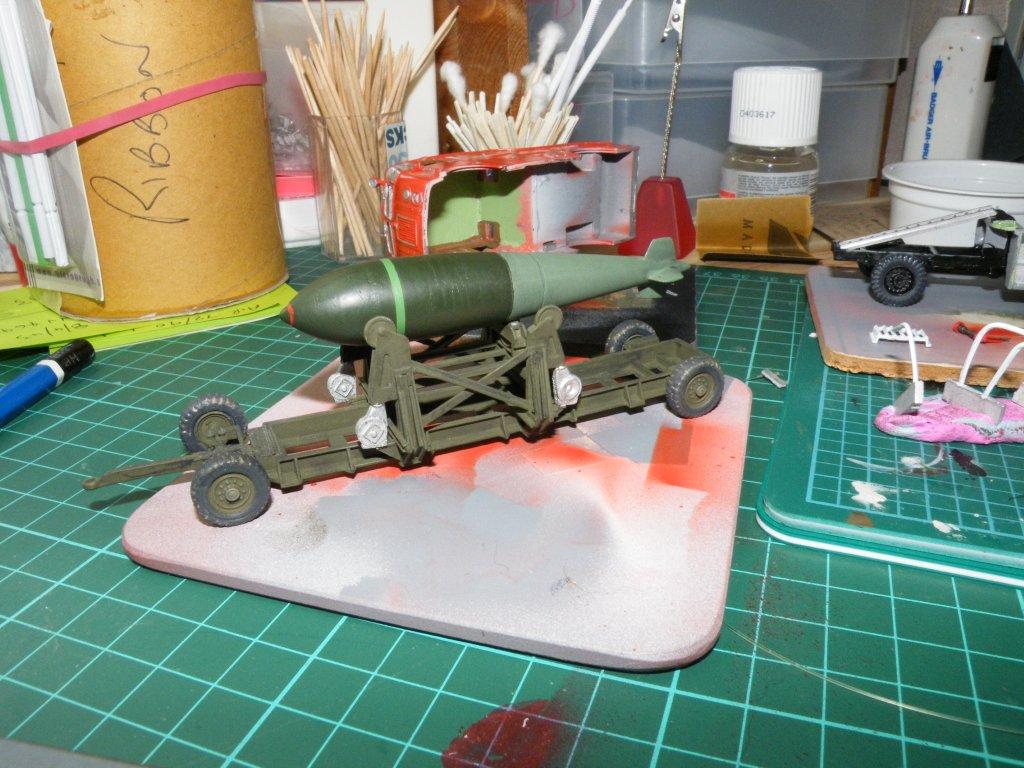
Here is Tallboy ready to reap revenge !! thanks to Able for supplying the bomb
Replied by ted angus on topic Airfield 1/72 scale modelling
This image is hidden for guests.
Please log in or register to see it.
Please Log in or Create an account to join the conversation.
- redironbark
- Offline
- New Member
-

Less
More
- Posts: 2
- Thank you received: 0
16 Oct 2010 02:51 #78
by redironbark
Replied by redironbark on topic Airfield 1/72 scale modelling
Ted,
Excellent models. Thanks for posting. A couple of points though on camouflage. You quote that:
"early 1944 SCC15 plus SCC14, Sept 1944 SCC15 on its own"
No doubt you got this from Hodges and Taylor's excellent "British Military Markings" or based it on photos alone. I believe this was only inferred by Taylor and not based on any published order that I know of. Furthermore, when SCC15 was introduced, no where does it say that the disruptive colour was to be black. In fact I have a photo of a Carrier with a light disruptive colour. Since then more up to date documents have appeared and when SCC15 was introduced, no pattern painting was intended to have been used. We know this from Canadian orders found by historian Steve Guthrie. In fact the whole of 21st Army Group were Olive Drab only (see attached below).
Regards,
Mark Mackenzie
**********************************************************************************************************
War Diary
HQ First Canadian Army
AA & QMG Branch
A/Q Conference
26 April 1944
Item 119:
ACI533 has authorized the basic colour of camouflage paint to be changed to the US Army Olive Drab. AQMG(AE) to take this up with G(SD) and G(OPS) to assertain the G is agreeable to the change - advised all 21 AG veh are now painted with O.D. Colour with no attempt at camouflage.
**********************************************************************************************************
HQ First Canadian Army
AA & QMG Branch
A/Q Conference
1 May 1944
Item 138
Advised C of S has approved the repainting of all Cdn Army Veh in Olive Drab colour w/ no camouflage
**********************************************************************************************************
4 Canadian Armoured Division Provisional Operational Standing Orders
11 June 1944
Section 21 Camouflage
2 (a) A veh: One colour only will be used which may be any of the following:
SCC Number 1A (dark brown)
SCC Number 7 (dark green)
Olive Drab (dark green)
*********************************************************************************************************
Excellent models. Thanks for posting. A couple of points though on camouflage. You quote that:
"early 1944 SCC15 plus SCC14, Sept 1944 SCC15 on its own"
No doubt you got this from Hodges and Taylor's excellent "British Military Markings" or based it on photos alone. I believe this was only inferred by Taylor and not based on any published order that I know of. Furthermore, when SCC15 was introduced, no where does it say that the disruptive colour was to be black. In fact I have a photo of a Carrier with a light disruptive colour. Since then more up to date documents have appeared and when SCC15 was introduced, no pattern painting was intended to have been used. We know this from Canadian orders found by historian Steve Guthrie. In fact the whole of 21st Army Group were Olive Drab only (see attached below).
Regards,
Mark Mackenzie
**********************************************************************************************************
War Diary
HQ First Canadian Army
AA & QMG Branch
A/Q Conference
26 April 1944
Item 119:
ACI533 has authorized the basic colour of camouflage paint to be changed to the US Army Olive Drab. AQMG(AE) to take this up with G(SD) and G(OPS) to assertain the G is agreeable to the change - advised all 21 AG veh are now painted with O.D. Colour with no attempt at camouflage.
**********************************************************************************************************
HQ First Canadian Army
AA & QMG Branch
A/Q Conference
1 May 1944
Item 138
Advised C of S has approved the repainting of all Cdn Army Veh in Olive Drab colour w/ no camouflage
**********************************************************************************************************
4 Canadian Armoured Division Provisional Operational Standing Orders
11 June 1944
Section 21 Camouflage
2 (a) A veh: One colour only will be used which may be any of the following:
SCC Number 1A (dark brown)
SCC Number 7 (dark green)
Olive Drab (dark green)
*********************************************************************************************************
Please Log in or Create an account to join the conversation.
- ted angus
- Offline
- Platinum Member
-
Less
More
- Posts: 1643
- Thank you received: 51
16 Oct 2010 09:57 #79
by ted angus
Replied by ted angus on topic Airfield 1/72 scale modelling
Mark,, no my research is not based on anyones books etc its drawn entirerly on AMOs and ACIs. unearthed over many years research .
Firstly Remember a UK camo pattern comprises a basic colour and a disruptive colour.
you say you know of no order for SCC15 Olive Drab as the basic colour with SCC14 as disruptive colour well the order is AMO A519/1944 dated 8 june 1944 . it followed ACI 533 dated 12 april 1944 which if you read an original copy quotes SCC15 as the new basic colour not sole or overall colour but basic colour. and it is UK Olive Drab not US olive drab as you quote they are different colours. In the Canadian army it may well have been US OD but in the UK it was SCC15 . In the UK Army SCC15 OD became the overall colour via ACI 1100 12 August 1944 and in the RAF by AMO A 897/1944 14 sept 1944.
I have not seen your posts lately on other forums ?? but this is not the place to ask why; but can I politely remind you this is an Airfield forum not a forum for heated debates on the Canadian Army as I have seen elsewhere .
Firstly Remember a UK camo pattern comprises a basic colour and a disruptive colour.
you say you know of no order for SCC15 Olive Drab as the basic colour with SCC14 as disruptive colour well the order is AMO A519/1944 dated 8 june 1944 . it followed ACI 533 dated 12 april 1944 which if you read an original copy quotes SCC15 as the new basic colour not sole or overall colour but basic colour. and it is UK Olive Drab not US olive drab as you quote they are different colours. In the Canadian army it may well have been US OD but in the UK it was SCC15 . In the UK Army SCC15 OD became the overall colour via ACI 1100 12 August 1944 and in the RAF by AMO A 897/1944 14 sept 1944.
I have not seen your posts lately on other forums ?? but this is not the place to ask why; but can I politely remind you this is an Airfield forum not a forum for heated debates on the Canadian Army as I have seen elsewhere .
Please Log in or Create an account to join the conversation.
- redironbark
- Offline
- New Member
-
Less
More
- Posts: 2
- Thank you received: 0
16 Oct 2010 23:46 #80
by redironbark
Replied by redironbark on topic Airfield 1/72 scale modelling
Ted,
I think that we will have to agree to dissagree on the Olive Drab matters.
It is very good that you have made your research concerning RAF vehicle camouflage available for all to read via the internet forums. I have noticed that you have not published anything on the forums concerning pre-war camouflage. Although I have nothing for UK, in the Middle-East in the inter-war period the General Orders are given below (1936-1940). These may be helpful if you don't have them already. I assume that these were a consequence of the Abyssinian Crisis:
G.O. 73, 1936: Vehicles given rough finish by application of varnish sprinkled with sand. Then when varnish dry, camouflaged painted with Light Sand and Dark Sand paint.
G.O. 185, 1936: Sprinkled sand over varnish cancelled. Paint only used. Colours remained Light Sand/Dark Sand.
G.O. 40, January 1937: All R.A.O.C and R.A.S.C vehicles painted when they required painting in Light Sand/Dark Sand paint.
G.O. 13, 1938: Middle Stone replaced Light Sand. Camouflage colours then Middle-Stone/Dark Sand.
G.0. 370, November 1940: Middle Stone/Dark Sand continued as camouflage colours but pattern changed to regular sloping bands with width 3" -12" with average being 12".
Regards,
Mark Mackenzie
I think that we will have to agree to dissagree on the Olive Drab matters.
It is very good that you have made your research concerning RAF vehicle camouflage available for all to read via the internet forums. I have noticed that you have not published anything on the forums concerning pre-war camouflage. Although I have nothing for UK, in the Middle-East in the inter-war period the General Orders are given below (1936-1940). These may be helpful if you don't have them already. I assume that these were a consequence of the Abyssinian Crisis:
G.O. 73, 1936: Vehicles given rough finish by application of varnish sprinkled with sand. Then when varnish dry, camouflaged painted with Light Sand and Dark Sand paint.
G.O. 185, 1936: Sprinkled sand over varnish cancelled. Paint only used. Colours remained Light Sand/Dark Sand.
G.O. 40, January 1937: All R.A.O.C and R.A.S.C vehicles painted when they required painting in Light Sand/Dark Sand paint.
G.O. 13, 1938: Middle Stone replaced Light Sand. Camouflage colours then Middle-Stone/Dark Sand.
G.0. 370, November 1940: Middle Stone/Dark Sand continued as camouflage colours but pattern changed to regular sloping bands with width 3" -12" with average being 12".
Regards,
Mark Mackenzie
Please Log in or Create an account to join the conversation.
- Forum
- Open Forum
- Miscellaneous Research Topics
- Flight Sim Scenery Design and Scale Modelling
- Airfield 1/72 scale modelling
Time to create page: 0.056 seconds

![[IMG]/community/47730=2071-Completed Manchesters 007.jpg[/img]](/community/47730=2071-Completed%20Manchesters%20007.jpg)
![[IMG]/community/47730=2072-Completed Manchesters 011.jpg[/img]](/community/47730=2072-Completed%20Manchesters%20011.jpg)
![[IMG]/community/47730=2070-Completed Manchesters 018.jpg[/img]](/community/47730=2070-Completed%20Manchesters%20018.jpg)