- Posts: 5843
- Thank you received: 567
- Forum
- Open Forum
- Miscellaneous Research Topics
- Flight Sim Scenery Design and Scale Modelling
- Airfield modelling (Airfix / Hornby / Lego etc)
Airfield modelling (Airfix / Hornby / Lego etc)
- Paul Francis
-

- Offline
- Moderator
-

Less
More
04 Feb 2013 20:37 #81
by Paul Francis
You can tell a builder from an archaeologist by the size of his trowel. Mine is a small one!
Replied by Paul Francis on topic Airfield modelling (Airfix / Hornby / Lego etc)
Looks pretty good to me
You can tell a builder from an archaeologist by the size of his trowel. Mine is a small one!
Please Log in or Create an account to join the conversation.
- mawganmad
-

- Offline
- Platinum Member
-

Less
More
- Posts: 2807
- Thank you received: 18
04 Feb 2013 21:37 #82
by mawganmad
James Thomas
Replied by mawganmad on topic Airfield modelling (Airfix / Hornby / Lego etc)
Weren't some towers only rendered up to the dado, with unfinished brick from there up?
James Thomas
Please Log in or Create an account to join the conversation.
- Paul Francis
-
- Offline
- Moderator
-
Less
More
- Posts: 5843
- Thank you received: 567
04 Feb 2013 21:50 #83
by Paul Francis
You can tell a builder from an archaeologist by the size of his trowel. Mine is a small one!
Replied by Paul Francis on topic Airfield modelling (Airfix / Hornby / Lego etc)
Correct MM
You can tell a builder from an archaeologist by the size of his trowel. Mine is a small one!
Please Log in or Create an account to join the conversation.
- mawganmad
-
- Offline
- Platinum Member
-
Less
More
- Posts: 2807
- Thank you received: 18
04 Feb 2013 21:53 #84
by mawganmad
James Thomas
Replied by mawganmad on topic Airfield modelling (Airfix / Hornby / Lego etc)
Sorry I was stating the bleedin obvious there! I mean unpainted above the line, ie just natural brick?
James Thomas
Please Log in or Create an account to join the conversation.
- Paul Francis
-
- Offline
- Moderator
-
Less
More
- Posts: 5843
- Thank you received: 567
04 Feb 2013 22:40 #85
by Paul Francis
You can tell a builder from an archaeologist by the size of his trowel. Mine is a small one!
Replied by Paul Francis on topic Airfield modelling (Airfix / Hornby / Lego etc)
No, the cream distemper has faded, there are patches of it.
You can tell a builder from an archaeologist by the size of his trowel. Mine is a small one!
Please Log in or Create an account to join the conversation.
- dfernetti
- Offline
- New Member
-

Less
More
- Posts: 7
- Thank you received: 0
04 Feb 2013 22:52 #86
by dfernetti
Replied by dfernetti on topic Airfield modelling (Airfix / Hornby / Lego etc)
Thanks! Well, about the rendering up to the dado line, my references are inconsistent (seems like some towers or RAF buildings had a tidier appareance than others!) But all seem to indicate that the building interiors were painted up completely.
Here are a couple of contradictory examples about the rendering. On reflection, maybe none of these rooms were located in a watch tower? I gleaned the files from the web.
Painted, not rendered:
This image is hidden for guests.
This one sure doesn't describe a control tower room, but yet:
media.iwm.org.uk/iwm/mediaLib/39/media-39946/large.jpg
Painted and wholly rendered:
This image is hidden for guests.
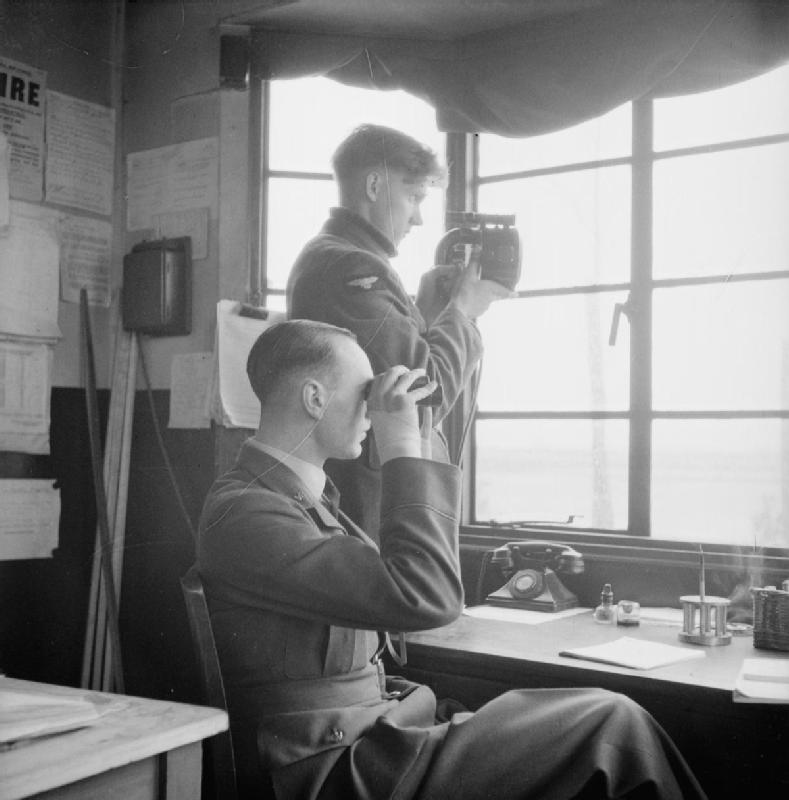
The duty officer in the tower at RAF Catfoss in Yorkshire keeps watch while an airman signals to an aircraft using an Aldis lamp, April 1941. Catfoss was home to No 2 (Coastal) OTU.
This latter has a different window configuration than the usual wartime design... maybe it's one of the more involved buildings from the prewar period?
Contemporary pictures of RAF Elvington show a mixed option: rendered up to the dado line and exposed brickwork painted up to the roof.
I'm spoiled for choices!
D.
Here are a couple of contradictory examples about the rendering. On reflection, maybe none of these rooms were located in a watch tower? I gleaned the files from the web.
Painted, not rendered:
This image is hidden for guests.
Please log in or register to see it.
This one sure doesn't describe a control tower room, but yet:
media.iwm.org.uk/iwm/mediaLib/39/media-39946/large.jpg
Painted and wholly rendered:
This image is hidden for guests.
Please log in or register to see it.
The duty officer in the tower at RAF Catfoss in Yorkshire keeps watch while an airman signals to an aircraft using an Aldis lamp, April 1941. Catfoss was home to No 2 (Coastal) OTU.
This latter has a different window configuration than the usual wartime design... maybe it's one of the more involved buildings from the prewar period?
Contemporary pictures of RAF Elvington show a mixed option: rendered up to the dado line and exposed brickwork painted up to the roof.
I'm spoiled for choices!
D.
Please Log in or Create an account to join the conversation.
- Paul Francis
-
- Offline
- Moderator
-
Less
More
- Posts: 5843
- Thank you received: 567
05 Feb 2013 09:06 #87
by Paul Francis
You can tell a builder from an archaeologist by the size of his trowel. Mine is a small one!
Replied by Paul Francis on topic Airfield modelling (Airfix / Hornby / Lego etc)
As a general rule WWII built two storey control towers / watch offices were rendered up to dado height, including the stair case walls which is similar to some permament buildings. The last pic above is a single storey watch office located on at an relief landing ground - basically a hut I suspect. The other pics that you found being un-rendered are WWII huts where walls are fair face which are the majority of hutting (it actually says this on the original drawings (ff) meaning fair face ready for painting). There is no inconsistancy huts un-rendered(generally), control towers rendered up to dado height. There always will be exceptions but these are few.
You can tell a builder from an archaeologist by the size of his trowel. Mine is a small one!
Please Log in or Create an account to join the conversation.
- dfernetti
- Offline
- New Member
-
Less
More
- Posts: 7
- Thank you received: 0
05 Feb 2013 12:32 #88
by dfernetti
Replied by dfernetti on topic Airfield modelling (Airfix / Hornby / Lego etc)
Thanks! The rendered up to the dado it'll be. I eyeballed the dado height up to 1.2 m high. Am I too wrong about that?
2nd question: the stairs steps were also covered in linoleum as the rest of the floors?
3rd question: The doors, door frames and window frames seem to be frequently painted (in the decaying abandoned buildings) in a sort of darker version of the green of the walls. Is this a suitable wartime custom?
4) In the last picture I see that they have "blackout curtains". I assume that these could be fitted to all windows on a watch tower (even the roof observation hut) Is that correct? Are these curtains made of just heavy black cloth?
Sorry if this has been discussed elsewhere in the forum! If so, please direct me to the correct thread.
Thanks in advance!
2nd question: the stairs steps were also covered in linoleum as the rest of the floors?
3rd question: The doors, door frames and window frames seem to be frequently painted (in the decaying abandoned buildings) in a sort of darker version of the green of the walls. Is this a suitable wartime custom?
4) In the last picture I see that they have "blackout curtains". I assume that these could be fitted to all windows on a watch tower (even the roof observation hut) Is that correct? Are these curtains made of just heavy black cloth?
Sorry if this has been discussed elsewhere in the forum! If so, please direct me to the correct thread.
Thanks in advance!
Please Log in or Create an account to join the conversation.
- Paul Francis
-
- Offline
- Moderator
-
Less
More
- Posts: 5843
- Thank you received: 567
05 Feb 2013 15:09 #89
by Paul Francis
You can tell a builder from an archaeologist by the size of his trowel. Mine is a small one!
Replied by Paul Francis on topic Airfield modelling (Airfix / Hornby / Lego etc)
That is a remarkable amount of detail for a very inaccurate model. I can answer a few of your questions:
1. you probably are correct but needs checking
2. no bare concrete
3. the doors and frames etc are the same colour as below dado the fading is less so on wood than brick so they show up darker today.
4. blackout curtains are thick cloth - all over
1. you probably are correct but needs checking
2. no bare concrete
3. the doors and frames etc are the same colour as below dado the fading is less so on wood than brick so they show up darker today.
4. blackout curtains are thick cloth - all over
You can tell a builder from an archaeologist by the size of his trowel. Mine is a small one!
Please Log in or Create an account to join the conversation.
- dfernetti
- Offline
- New Member
-
Less
More
- Posts: 7
- Thank you received: 0
05 Feb 2013 17:12 #90
by dfernetti
Replied by dfernetti on topic Airfield modelling (Airfix / Hornby / Lego etc)
Yes... I was aware of the evident innacuracies of the kit soon after I put my grubby paws on it... Yet I see it as a chance to make an interesting backdrop for other types of models, like vehicles, figures, ancillary equipment and diorama landscaping. I'm also interested to learn some architectural modelling techniques, like making different types of stairs, railings, inner structures and small furniture. For that reason I'll make my Watch Tower as belonging to a fictional RAF base (I've written a list of silly names to choose) in an indeterminate time period between 1939 and 1945 (as I shall change and add features as time allows). I plan to mount the building in a reasonably large base (let's say no bigger than A3 size) to have space to add a couple of hutsand areas of both tarmac and grass.
Thanks for the answers!
D.
Thanks for the answers!
D.
Please Log in or Create an account to join the conversation.
- Forum
- Open Forum
- Miscellaneous Research Topics
- Flight Sim Scenery Design and Scale Modelling
- Airfield modelling (Airfix / Hornby / Lego etc)
Time to create page: 0.049 seconds